
SAT Exponents and Radicals Worksheet
Multiplying powers with the same base adds exponents; raising a power to another power multiplies them. A negative exponent means a reciprocal. These rules apply to products, not to separate terms across a plus sign.

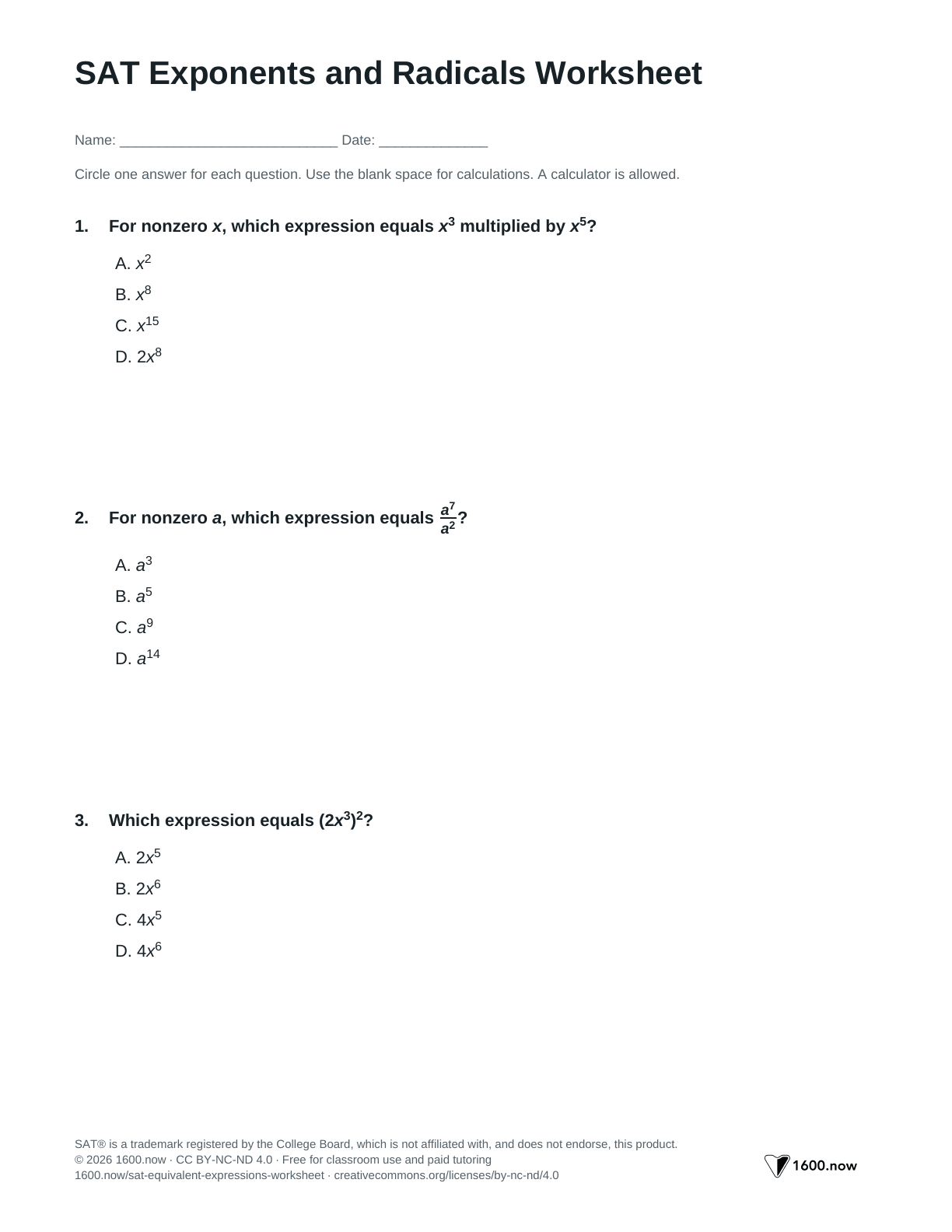
The 12 exponents-and-radicals questions below also cover binomial squares, factoring, and rational expressions. The printable student copy hides the answers; the full PDF includes explanations. Choose Letter or A4.
12 questions · about 25 minutes · Advanced Math › Equivalent expressions
Share to Google Classroom · This worksheet is free to print and share under CC BY-NC-ND 4.0. Tutors may also use it in paid sessions. If you post it online, please link to this page instead of re-uploading the PDF. These are original questions, not College Board items.
Check equivalence without losing terms
For nonzero , , , and . If the power surrounds a product, apply it to each factor: .
Simplify a radical by separating a perfect-square factor: . Squaring the result gives , which checks the simplification.
Factor the entire numerator before canceling a rational expression. Keep every restriction from the original denominator. Testing one allowed value of can disprove an answer, but matching at one value does not prove equivalence; expand or factor to establish that.
Try it yourself
Choose an answer.
Questions
Question 1
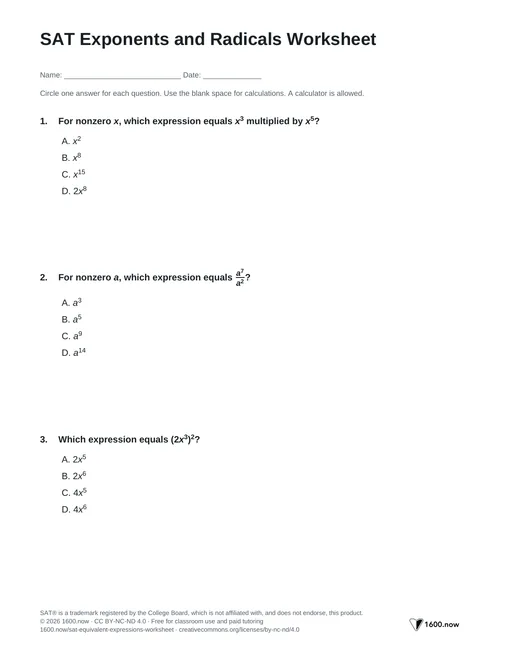
For nonzero , which expression equals multiplied by ?
B. Multiplication of powers with the same base adds the exponents: , giving .
Question 2
For nonzero , which expression equals ?
B. For a quotient with the same nonzero base, subtract exponents: .
Question 3
Which expression equals ?
D. Square both factors: and . Their product is .
Question 4
What is ?
A. The square root denotes the nonnegative number whose square is 144. Since , the value is 12.
Question 5
Which expression equals ?
A. Factor 72 as 36 times 2. Taking the square root gives .
Question 6
For positive , which expression equals ?
B. The square root halves the exponent when is positive: .
Question 7
If , what is ?
B. Repeated multiplication gives . Therefore the exponent is 5.
Question 8
For nonzero , which expression equals ?
A. A negative exponent means reciprocal: . It does not mean that the value itself must be negative.
Question 9
If , what is ?
B. Since , the exponents satisfy . Dividing by 2 gives .
Question 10
Which expression equals ?
C. Multiplying produces , which combines to .
Question 11
Which expression equals ?
B. This is a difference of squares: . The middle terms cancel.
Question 12
For not equal to 3, which expression equals ?
B. Factor the numerator as . Cancel only when is not 3, leaving .
0/12 correct
Check your exponent answers
Each row is a wrong answer choice from one of the sheet's problems. Find the one you picked, then run the check in the last column.
| What your answer looked like | What actually happened | Fix it next time |
|---|---|---|
| for (problem 1) | You multiplied the exponents. That rule is for a power of a power, like . | Multiplying powers with the same base adds the exponents: 3 factors of times 5 more is 8 factors, so . |
| for (problem 3) | The square reached but skipped the 2. An exponent outside parentheses applies to every factor inside. | Write it as . Check with : , while gives 2. |
| 36 for (problem 5) | You halved 72. A square root asks which number times itself gives 72, and . | Pull out the largest perfect-square factor: , so . Check: . |
| for (problem 8) | A negative exponent means reciprocal, not a negative number: . | Test : is positive, but . The expression that matches is . |
| from (problem 9) | You solved for and stopped. Writing gives , and the question asks for . | Divide by 2 to get , then plug it back in: . With you'd get . |
| for (problem 10) | You squared each term separately and lost the middle term. means , which produces twice. | Test : , but . The full expansion gives . |
| for (problem 11) | expands to , which has a middle term and ends in . | A difference of squares factors into one minus and one plus: . Expand it to check: and cancel, leaving . |
Worked example: simplifying a fraction by factoring
Problem 12 asks which expression equals for . Dividing term by term, and , produces the choice , and it's wrong: you can cancel only a factor of the whole numerator against a factor of the whole denominator.
So factor first. The numerator is a difference of squares, , and cancelling the shared leaves . The condition is there because the original denominator is 0 at . Check with : , and . The other choices give 2, 28, and 1.
Apply the check to fresh questions
Retry a missed expression by expanding both sides or factoring the original. Then test an allowed value as a check. The practice link gives more equivalent-expression questions.
Review the equivalent expressions method