
SAT Quadratic Functions Worksheet
For a quadratic in vertex form, , the vertex is . When , the minimum output is ; when , the maximum output is . That output differs from the input where it occurs.

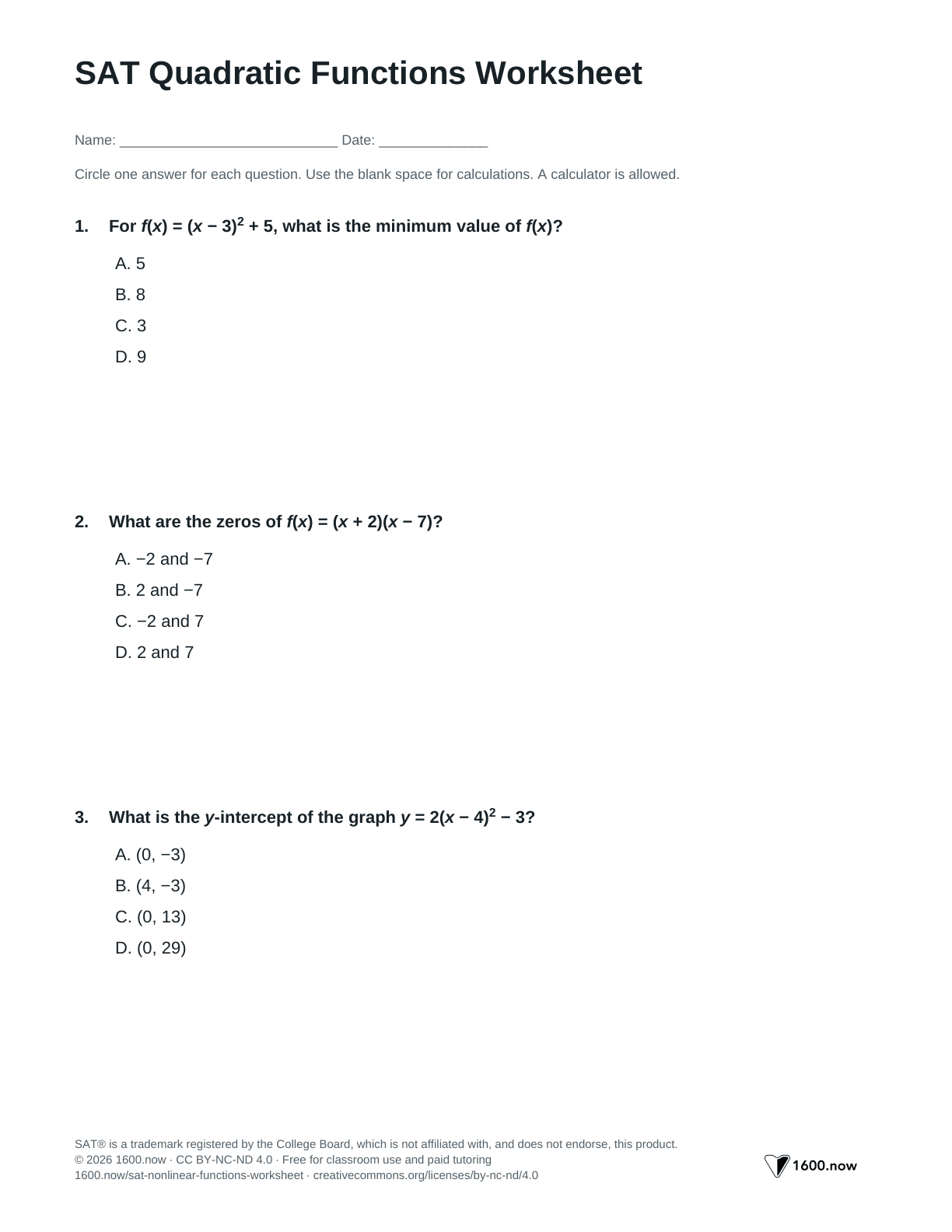
These 12 quadratic-function questions cover vertices, zeros, intercepts, and functions built from points. Print the student worksheet or download the PDF with explanations.
12 questions · about 25 minutes · Advanced Math › Nonlinear functions
Share to Google Classroom · This worksheet is free to print and share under CC BY-NC-ND 4.0. Tutors may also use it in paid sessions. If you post it online, please link to this page instead of re-uploading the PDF. These are original questions, not College Board items.
Use the form that exposes the feature you need
Vertex form exposes the turning point. Factored form exposes the zeros and . Standard form exposes the -intercept . Choose the form that answers the question with the least rearranging.
Zeros or a vertex may leave the leading coefficient unknown. Use an additional point to find . For a vertex and point , substitute into to get , so .
Check symmetry around , or around in standard form. Inputs equally far from that axis have equal outputs. Keep input, output, and the ordered pair distinct when selecting the final answer.
Try it yourself
Choose an answer.
Questions
Question 1
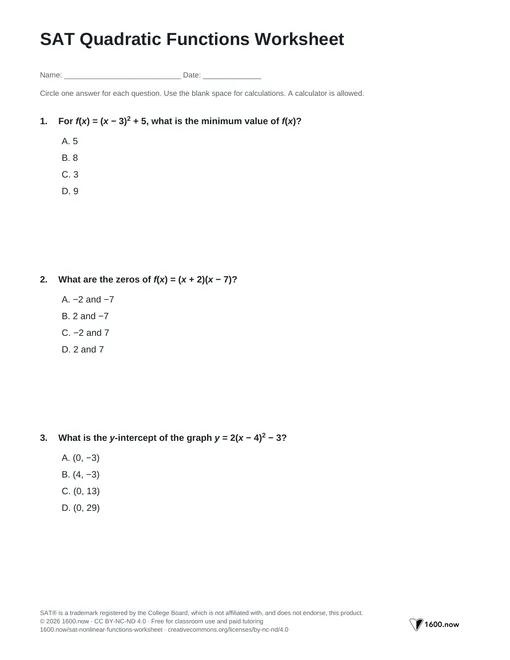
For , what is the minimum value of ?
A. A square is nonnegative. Its smallest value is 0, attained at . Therefore the minimum output is 5, not the x-coordinate 3.
Question 2
What are the zeros of ?
C. Set each factor equal to zero: gives -2, and gives 7.
Question 3
What is the -intercept of the graph ?
D. At the -intercept . Then , so the point is (0, 29). The vertex is (4, −3).
Question 4
The height , in meters, of a modeled object seconds after launch is . What is its maximum height?
B. The vertex occurs at . Evaluate meters. The time 2 is not the requested height.
Question 5
A quadratic has zeros 1 and 5 and passes through (0, 10). Which equation represents it?
A. The zeros imply . At , , so .
Question 6
If , what is the minimum value of ?
C. Complete the square: . The minimum output is −5, attained at .
Question 7
The function has its maximum at which value of ?
B. The negative coefficient makes the parabola open downward. Its vertex is (−1, 8), so the maximizing input is .
Question 8
For , what is the smaller zero?
C. Factor as . The zeros are 2 and 4, and the smaller is 2.
Question 9
A quadratic function has vertex (2, 3) and passes through (4, 11). What is ?
C. Use . Since , . Then .
Question 10
If , what is the positive difference between its two zeros?
C. Set . The roots are and , whose positive difference is 6.
Question 11
A rectangle has perimeter 40 meters. If its width is meters, its area is . What is its greatest possible area?
C. . The maximum is 100 square meters when both sides are 10 meters.
Question 12
If and the axis of symmetry is , what is ?
A. For , the axis is . Set to obtain .
0/12 correct
Check your quadratics answers
Each row is a wrong answer choice from one of the sheet's problems. Find the one you picked, then run the check in the last column.
| What your answer looked like | What actually happened | Fix it next time |
|---|---|---|
| 3 for the minimum of (problem 1) | 3 is where the minimum happens, the -coordinate of the vertex. The minimum value is the output there. | is smallest at 0, so the minimum is . Problem 4 is the same trap: the height peaks at , and the height is meters. |
| 2 and for the zeros of (problem 2) | Both signs are reversed. gives . | Set each factor equal to 0 and solve: and 7. Check: , but . |
| or for the y-intercept of (problem 3) | is the -value of the vertex, not the y-intercept. 13 comes from , which drops the 2. | Set and keep every factor: . |
| in problem 5 | Zeros at 1 and 5 fix the factors but not the leading coefficient. This choice assumes . | Use the third point. At , , so . Check the choice you picked: , not 10. |
| 11 for the minimum of (problem 6) | 11 is , the y-intercept. The minimum is at the vertex, . | Complete the square: , so the minimum is . Check: . |
| in problem 12 | You used . The axis of symmetry is . | gives . Check: . |
Worked example: building the function from its vertex
Problem 9 describes a quadratic with vertex that passes through , and asks for . The vertex fills in everything except : . Substitute the other point: , so and .
Now . Symmetry gives a quick check: 0 and 4 are both 2 units from the axis , so must equal , which is 11. The choice 7 skips finding and uses , and the choice 3 is the -value of the vertex.
Apply the check to fresh questions
On a fresh quadratic question, label the requested feature before calculating. Check your result using the intercept, a known point, or symmetry, then continue with nonlinear-functions practice.
Review the nonlinear functions method