
SAT Linear Equations Worksheet
Solve a one-variable linear equation by performing the same operation on both sides. Distribute across every term, clear fractions carefully, and check the final value in the original equation.

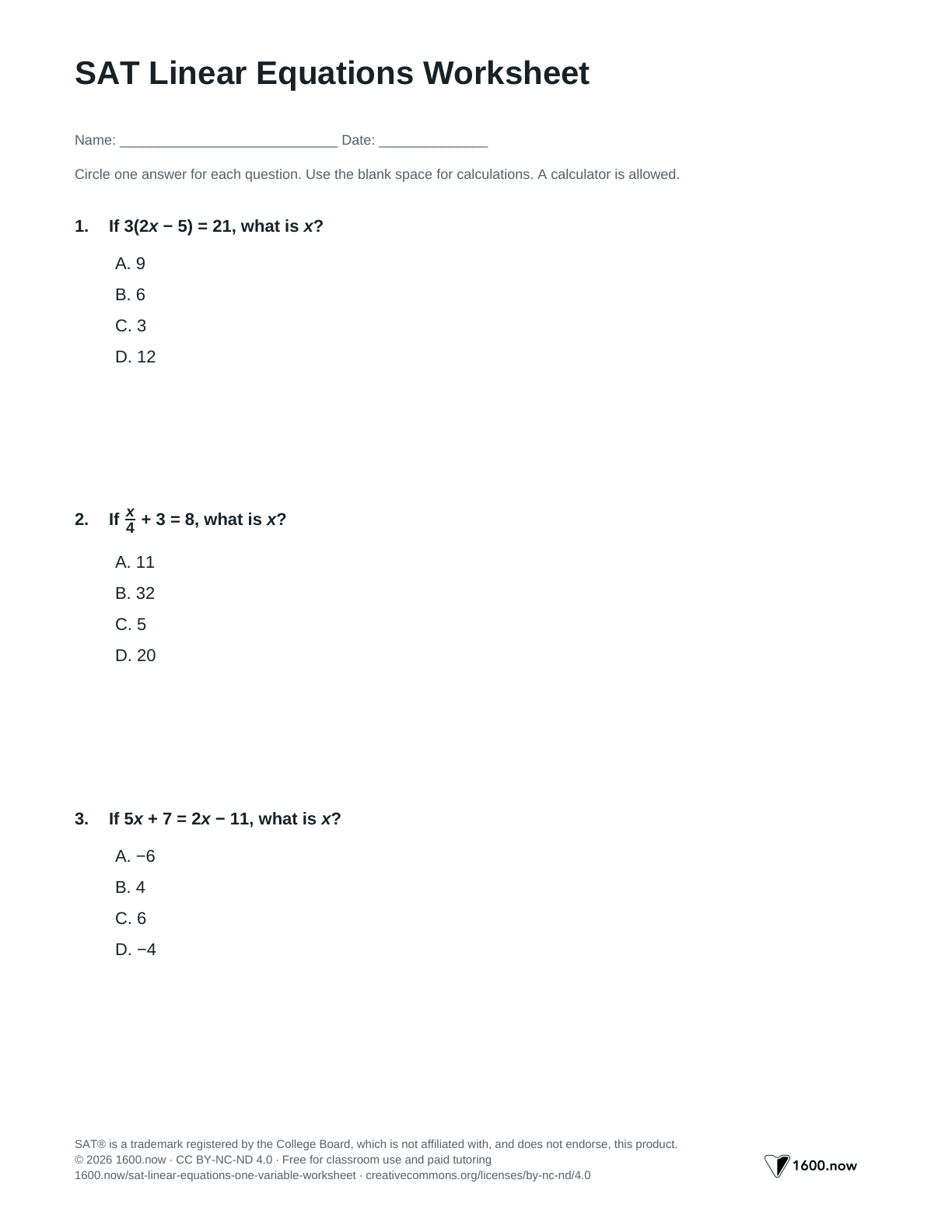
This 12-question worksheet includes word problems, constants, and equations with one, no, or infinitely many solutions. Download a student PDF for an attempt without answers or choose the full explained version.
12 questions · about 25 minutes · Algebra › Linear equations in one variable
Share to Google Classroom · This worksheet is free to print and share under CC BY-NC-ND 4.0. Tutors may also use it in paid sessions. If you post it online, please link to this page instead of re-uploading the PDF. These are original questions, not College Board items.
Simplify before deciding how many solutions exist
Distribute first, then collect the variable terms on one side and the constants on the other. For , distribution gives , then and . Substitution gives .
After simplifying, an equation of the form has one solution when . If and , it has no solution. If both are zero, every allowed value works. A parameter question asks which coefficient produces one of these cases.
In a word problem, define what measures and distinguish an amount remaining from an amount used. Reread the requested expression at the end: finding does not finish a question asking for .
Try it yourself
Choose an answer.
Questions
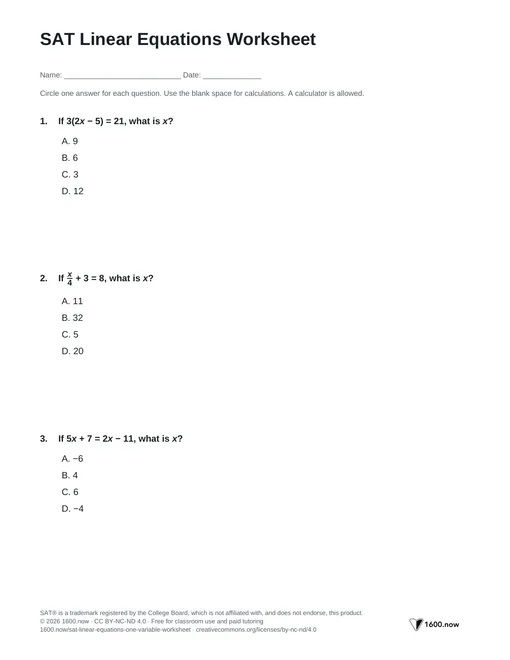
Question 1
If , what is ?
B. Distribute: . Add 15 to get , so . Checking gives .
Question 2
If , what is ?
D. Subtract 3: . Multiply both sides by 4 to obtain .
Question 3
If , what is ?
A. Subtract and 7 from both sides: . Divide by 3 to obtain .
Question 4
A repair costs a fixed fee of $35 plus $18 per hour. A customer pays $107 before tax. How many hours of work are charged?
C. Set . Then , so hours. The fixed fee is paid once.
Question 5
For which value of does the equation have no solution?
B. No solution occurs when the coefficients are equal but constants differ. With , subtracting gives the false statement .
Question 6
The equation is true for every real . What is ?
A. Expand to . For every , the constants must agree: , so .
Question 7
If , what is ?
C. Distribute and combine like terms: becomes . Subtract 8 to obtain .
Question 8
If , what is ?
B. Multiply both sides by 5: . Adding 3 gives , so .
Question 9
A tank initially contains 120 liters of water and drains at 8 liters per minute. After how many minutes will 56 liters remain?
B. Set . The tank loses 64 liters, so minutes.
Question 10
If , what is ?
C. Multiply by 15 to get . Thus , giving and .
Question 11
For which value of does have infinitely many solutions?
B. The right side expands to . The equations agree for every only if , so .
Question 12
If , what is ?
D. First solve , giving . The question asks for , which is .
0/12 correct
Check your linear equations answers
Each row is a wrong answer choice from one of the sheet's problems. Find the one you picked, then run the check in the last column.
| What your answer looked like | What actually happened | Fix it next time |
|---|---|---|
| 32 for (problem 2) | You multiplied 8 by 4 before dealing with the . That solves , a different equation. | Undo the addition first: , so . Check 32: , not 8. |
| 6 for (problem 3) | A sign slipped while you moved the constants. Subtracting 7 from gives , not 18. | From , . Check 6 in the original: the left side is , and the right side is . |
| 10 in problem 6 | The 2 outside the parentheses multiplies too, so the left side is , not . | Match the constants: , so . Problem 11 has the same trap: , so and , not 2. |
| 16 for (problem 8) | You subtracted 3 when you needed to add it. After multiplying by 5, the equation is . | Add 3 to get , so . Check: . |
| 7 or 15 in problem 9 | is how long 56 liters take to drain, and is when the tank is empty. The question says 56 liters remain. | Find what drains: liters, and minutes. Check: . |
| 6 or 12 in problem 12 | Those are and . The question asks for . | Solve for , then finish the expression: . |
Worked example: the equation with no solution
Problem 5 asks for the value of that gives no solution. Collect the -terms on one side and the constants on the other: , which is .
If isn't 0, you can divide by it and get exactly one solution, . If , the left side is , which is 0 for every , and is never true. So the answer is 7. With , the equation becomes , which has the solution . Problem 11 is the other case: when the -terms and the constants both match, every works.
Apply the check to fresh questions
On another linear-equations question, finish by substituting into the original equation and checking the requested quantity. The practice link provides fresh problems on the same skill.
Review the linear equations in one variable method