
SAT Nonlinear Equations and Systems Worksheet
Solve nonlinear equations by reducing them to a form you can factor, split into cases, or solve with the quadratic formula. Check every candidate in the original equation after squaring or clearing a denominator.

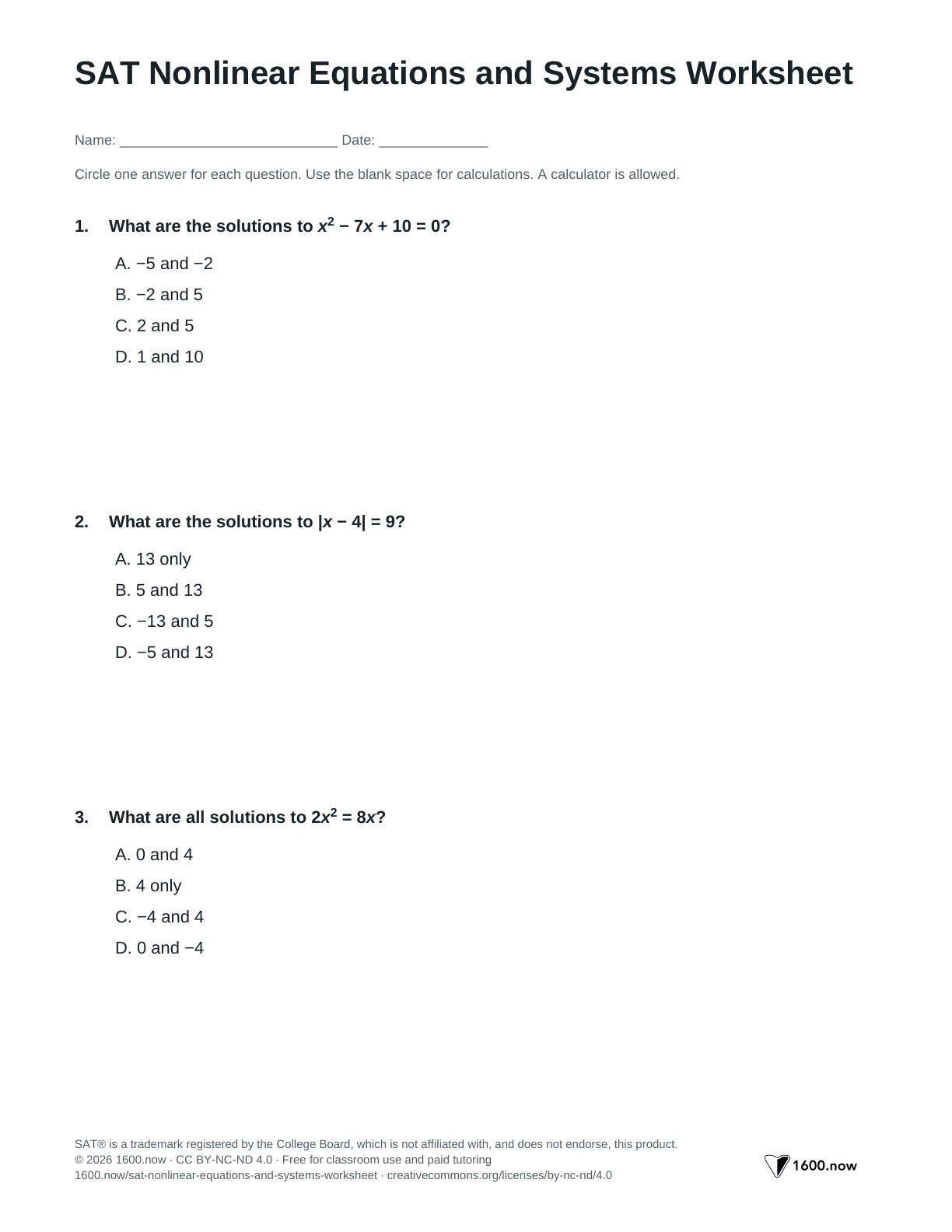
The 12 questions cover quadratics, absolute values, radicals, rational equations, and intersections of lines with parabolas. Choose a student PDF or the version with explained answers.
12 questions · about 25 minutes · Advanced Math › Nonlinear equations in one variable and systems of equations in two variables
Share to Google Classroom · This worksheet is free to print and share under CC BY-NC-ND 4.0. Tutors may also use it in paid sessions. If you post it online, please link to this page instead of re-uploading the PDF. These are original questions, not College Board items.
Keep restrictions with the equation
For with , solve and . For a quadratic, move all terms to one side and factor before dividing by a variable; division by can discard the solution .
A square-root expression is nonnegative. In , that immediately requires . Squaring may produce an algebraic candidate outside that condition. Substitution into the original equation is the final test.
Write excluded denominator values before clearing fractions. For a nonlinear system, substitute one equation into the other, solve for the possible -values, and compute each corresponding -value. Each intersection must satisfy both equations.
Try it yourself
Choose an answer.
Questions
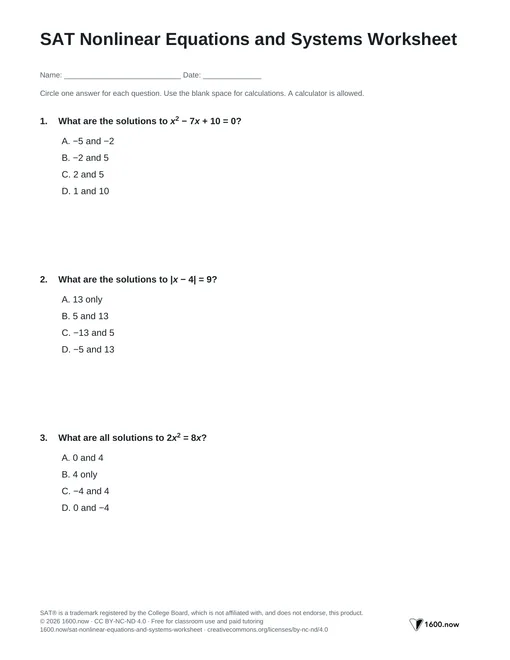
Question 1
What are the solutions to ?
C. Factor: , so or . Choice A has the signs reversed; those are the solutions to .
Question 2
What are the solutions to ?
D. The expression inside the absolute value bars equals 9 or . If , then . If , then .
Question 3
What are all solutions to ?
A. Move every term to one side: , so and or . Dividing both sides by loses the solution 0.
Question 4
What value of satisfies ?
C. Square both sides: , so . Check: is 4. Choice B comes from doubling 4 instead of squaring it.
Question 5
What is the solution to ?
D. Cross-multiply: , so and . Check: and . Choice A multiplies each numerator by its own denominator: .
Question 6
How many distinct real solutions does have?
A. The discriminant is . A negative discriminant means there are no real solutions.
Question 7
Which point is a solution to the system of equations and ?
B. A solution must satisfy both equations. For (3, 4), and . Choices A and C satisfy only the first equation, and choice D satisfies only the second.
Question 8
What are all values of that satisfy ?
C. Squaring gives , so . Check both: is 5, so 5 works. is 2, not −2, so −2 does not.
Question 9
What is the larger solution to ?
B. Complete the square: , so . The solutions are and . Choice D skips dividing by 2 in the quadratic formula.
Question 10
In the -plane, the graphs of and intersect at exactly one point, where is a constant. What is the value of ?
A. A horizontal line meets this upward-opening parabola exactly once, at its vertex. The vertex has and , so . Choice B is the -coordinate of the vertex.
Question 11
What value of satisfies ?
D. Multiplying both sides by gives , so . But makes both denominators 0, so it is not a solution, and the equation has no solution.
Question 12
The graphs of and in the -plane intersect at a point with -coordinate 4, where is a constant. What is the -coordinate of the other intersection point?
B. At , the parabola has , so and . Setting gives , or . The other intersection has . Choice D is the value of .
0/12 correct
Check your nonlinear equations answers
Each row is a wrong answer choice from one of the sheet's problems. Find the one you picked, then run the check in the last column.
| What your answer looked like | What actually happened | Fix it next time |
|---|---|---|
| 13 only in problem 2 | An absolute value equation has two cases. means is 9 or . | Solve both: or . Check : . |
| 4 only in problem 3 | Dividing both sides of by throws away , which also works. | Move everything to one side and factor: , so or . Check 0: and . |
| 3 in problem 4 | You doubled 4 instead of squaring it, so you solved . | Square both sides: , so . Check: . |
| in problem 5 | You multiplied each numerator by its own denominator: . Cross-multiplying pairs each numerator with the other fraction's denominator. | gives , so . Check: and . |
| and 5 in problem 8, or 3 in problem 11 | Squaring in problem 8 and multiplying by in problem 11 each produced a value that fails the original equation. , not , and makes both denominators in problem 11 equal 0. | Check every candidate in the original equation. Problem 8 keeps only 5, and problem 11 has no solution. |
| in problem 9 | That's the numerator of the quadratic formula before you divide by . | , so the larger solution is . |
Worked example: a parabola and a line with an unknown constant
Problem 12 says the graphs of and meet at a point with -coordinate 4, and asks for the other intersection. Find first. On the parabola, gives , so is on the line too: , and .
Now set the two expressions equal: , which becomes , or . The root is the point you were given, so the answer is . Check: at , the parabola gives and the line gives . The choice 9 is , and 3 has the wrong sign.
Apply the check to fresh questions
For another nonlinear equation, carry restrictions alongside your work and test every candidate. Use the practice link for fresh radical, rational, and system questions.
Review the nonlinear equations and systems method