
SAT Inequalities Worksheet
Solve a linear inequality with the same algebra as an equation, except that multiplying or dividing by a negative number reverses the inequality sign. Then check the endpoint and the direction of the solution set.

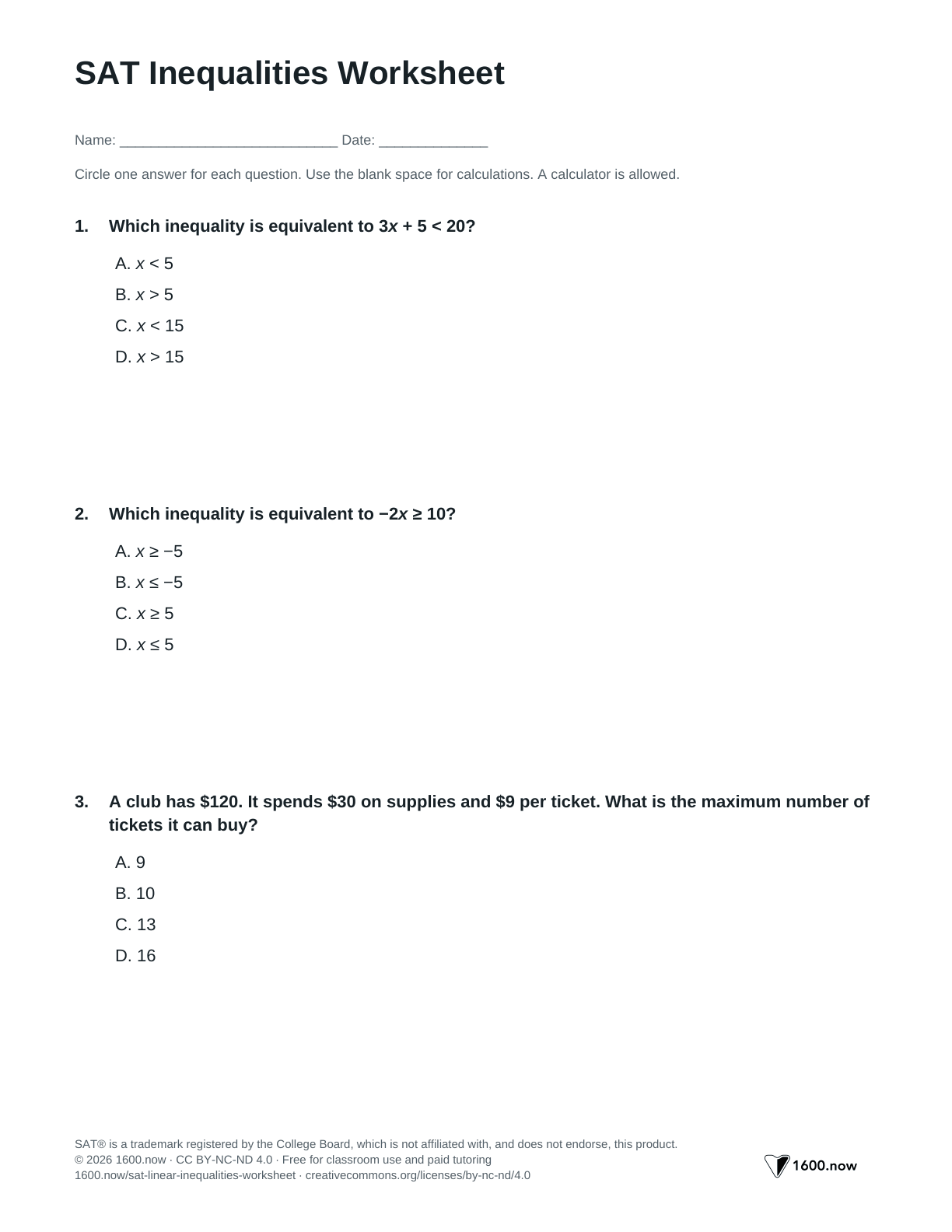
This 12-question worksheet covers strict and inclusive limits, budgets, whole-number constraints, and systems. Print a student copy or download the PDF with explained answers.
12 questions · about 25 minutes · Algebra › Linear inequalities in one or two variables
Share to Google Classroom · This worksheet is free to print and share under CC BY-NC-ND 4.0. Tutors may also use it in paid sessions. If you post it online, please link to this page instead of re-uploading the PDF. These are original questions, not College Board items.
Test the boundary and an allowed value
An addition or subtraction leaves the inequality direction unchanged. Multiplying or dividing by a negative reverses it: gives . Test and in the original to confirm which side works.
A strict sign, or , excludes the endpoint; or includes it. A point on the line does not satisfy , because equality is excluded.
For whole-number amounts, use the question’s limit to choose how to round. A maximum count cannot exceed a budget; a minimum number of work hours must meet the earnings target. Substitute the chosen integer and its neighboring integer to check the boundary.
A point in a system must satisfy every inequality. Test each condition separately instead of stopping after the first one passes.
Try it yourself
Choose an answer.
Questions
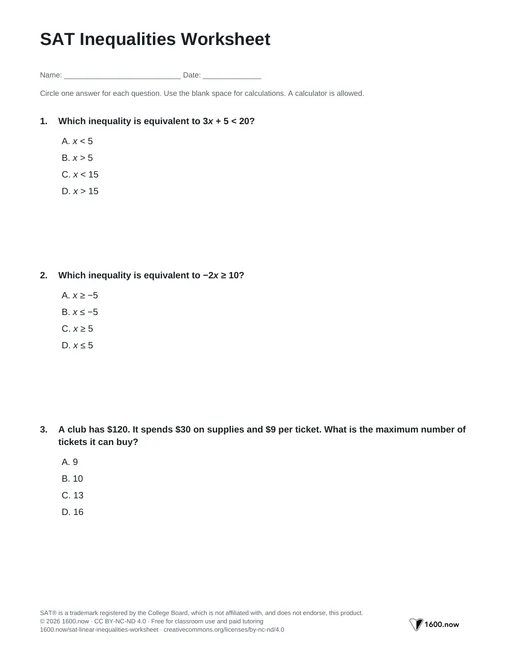
Question 1
Which inequality is equivalent to ?
A. Subtract 5 and divide by positive 3: becomes . The inequality direction stays the same.
Question 2
Which inequality is equivalent to ?
B. Divide by and reverse the inequality direction. The result is .
Question 3
A club has $120. It spends $30 on supplies and $9 per ticket. What is the maximum number of tickets it can buy?
B. The budget inequality is . Thus , and ten tickets can be purchased.
Question 4
Which value satisfies both and ?
C. The interval includes numbers greater than −2 and at most 3. Only 2 meets both conditions.
Question 5
Which point satisfies ?
C. At , the boundary has , and . The other points are on or below the boundary.
Question 6
If , which inequality describes ?
B. Subtract 5 to get . Dividing by −1 reverses the sign, giving .
Question 7
A truck can carry at most 900 kilograms. A machine weighs 260 kilograms and each box weighs 40 kilograms. What is the maximum number of boxes it can also carry?
B. There are kilograms available. Dividing by 40 gives 16 boxes.
Question 8
Which inequality is equivalent to ?
C. Expand to . Subtract and add 8 to obtain .
Question 9
An integer satisfies . What is the largest possible value of ?
B. The inequality gives . The largest integer below 4.25 is 4.
Question 10
Which point satisfies both and ?
C. For (3, 3), and . Each other point violates at least one condition.
Question 11
A student earns $12 per hour. What is the least number of whole hours the student must work to earn at least $100?
C. The inequality gives . Nine is the smallest whole number satisfying the requirement.
Question 12
Which inequality is equivalent to ?
B. Multiplying by −3 reverses the inequality: . Subtracting 6 gives .
0/12 correct
Check your inequalities answers
Each row is a wrong answer choice from one of the sheet's problems. Find the one you picked, then run the check in the last column.
| What your answer looked like | What actually happened | Fix it next time |
|---|---|---|
| for (problem 2) | You divided by without reversing the inequality. | Dividing by a negative flips the sign: . Test , which the wrong answer allows: , and 0 isn't at least 10. |
| 13 in problem 3 or 22 in problem 7 | You divided the whole limit by the cost or weight of one item and skipped the fixed part: the $30 of supplies, or the 260-kilogram machine. | Subtract the fixed amount first. Problem 3: tickets. Problem 7: boxes. |
| in problem 4 | is strict, so itself is left out. | Read each endpoint: and leave it out, and and include it. Of the choices, only 2 is greater than and at most 3. |
| or in problem 5 | Both points are on the line : and . The inequality needs points strictly above it. | Substitute and compare. For , , and . |
| 5 in problem 9 or 8 in problem 11 | You rounded the wrong way. In problem 9, , and breaks it: . In problem 11, 8 hours earns $96, which is less than $100. | Put your whole number back into the original inequality. The answers are 4 in problem 9 and 9 in problem 11. |
| in problem 10 | meets but not , since . | A point has to satisfy every inequality in the system. Check both for each choice. Only passes: and . |
Worked example: dividing by a negative
Problem 12 asks which inequality is equivalent to . Multiply both sides by to clear the fraction. Multiplying by a negative reverses the inequality, so becomes : . Subtract 6 to get .
Test one value on each side of . At , , and is true. At , , and is false. So the solutions are the numbers greater than . The choice keeps the original sign and includes .
Apply the check to fresh questions
For another inequality, test an endpoint and a value on each side. For a count, check the next integer too. Continue with the inequalities practice link.
Review the linear inequalities method