
SAT Desmos Worksheet
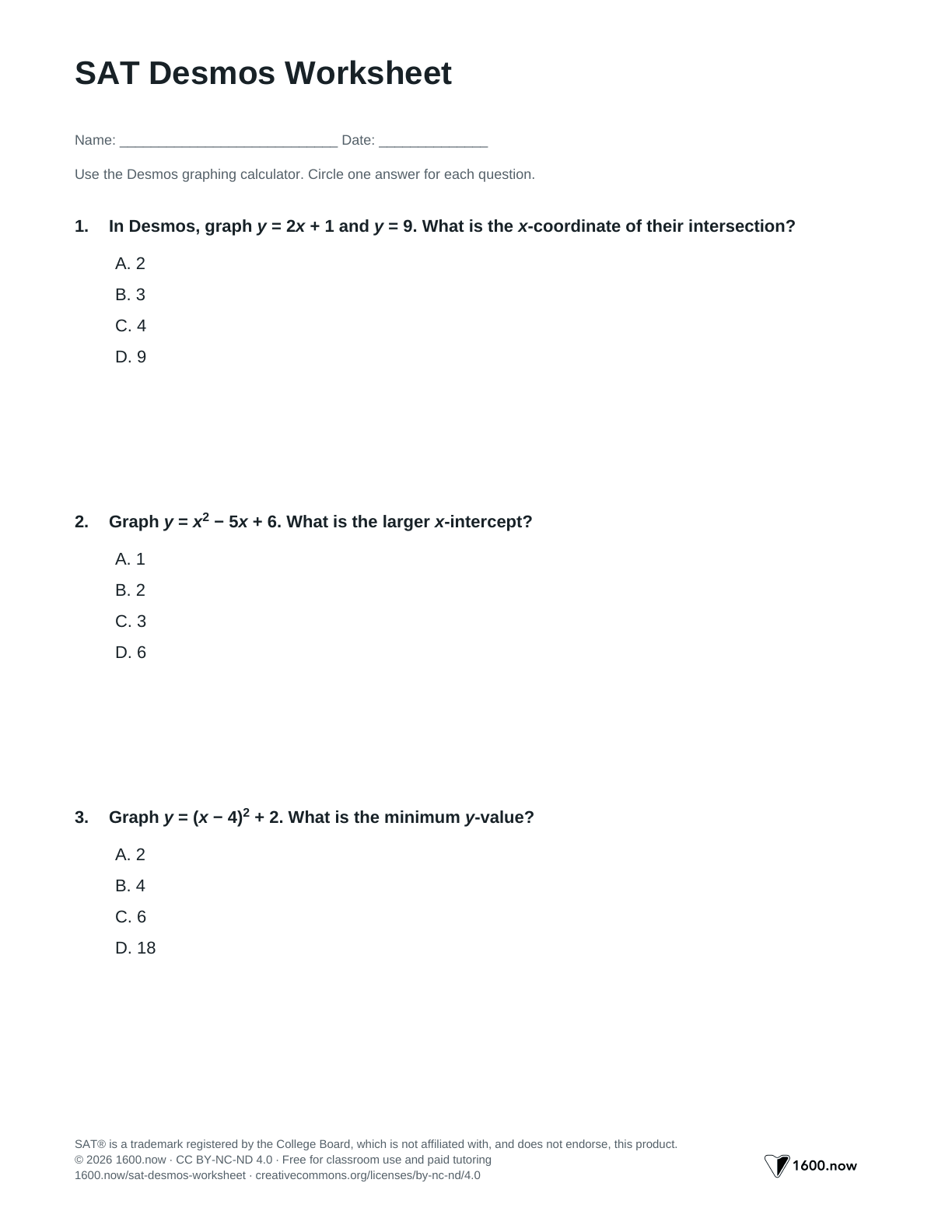
Use a graph to locate the feature a question asks for: an intersection, an intercept, a vertex, or a function value. Write down whether the requested answer is an input, an output, a count, or a difference before entering equations.

This 12-question Desmos worksheet pairs graph interpretation with algebraic checks. Use a graphing calculator alongside the printable student copy, or answer below and reveal the explanations.
12 questions · about 25 minutes · Math › mixed skills
Share to Google Classroom · This worksheet is free to print and share under CC BY-NC-ND 4.0. Tutors may also use it in paid sessions. If you post it online, please link to this page instead of re-uploading the PDF. These are original questions, not College Board items.
Turn the question into a graph feature
For an equation with two sides, graph each side as an output: solving means graphing and . Their intersection is , so the equation’s solution is the first coordinate, .
For a zero, locate where the graph meets the -axis. For a minimum or maximum, inspect the vertex’s output coordinate. A parabola that touches the axis at its vertex has one distinct -intercept, not two.
Adjust the viewing window if the required feature is outside it. A graph without a visible intersection is not proof that no intersection exists. Confirm a value by substituting into the equation, especially when the display rounds a coordinate.
For a difference between intercepts, subtract their input coordinates after reading both points. The vertex’s distance to one intercept is only half the separation when the intercepts are symmetric around it.
Try it yourself
Choose an answer.
Questions
Question 1
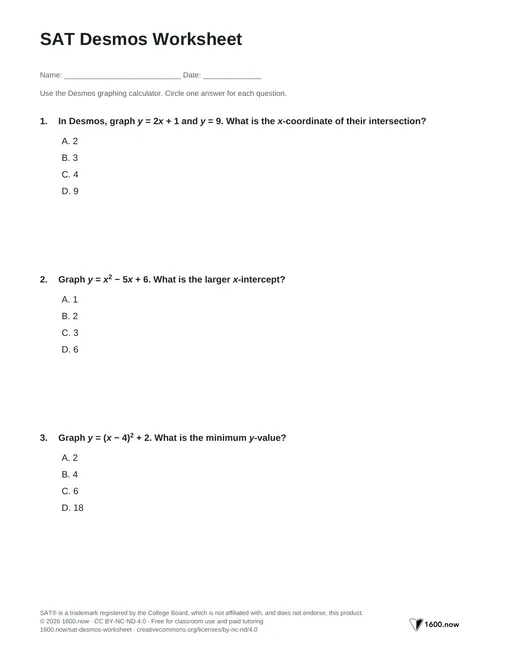
In Desmos, graph and . What is the -coordinate of their intersection?
C. At the intersection, . Solving gives ; the full point is .
Question 2
Graph . What is the larger -intercept?
C. The graph crosses the -axis where . The larger -coordinate is 3.
Question 3
Graph . What is the minimum -value?
A. The vertex is (4, 2). The question asks for the output at the minimum, which is 2, rather than the input 4.
Question 4
Graph and . What is the -coordinate of the intersection?
C. Set to get . Substitute to find , so the requested coordinate is 4.
Question 5
Graph and . What is the -coordinate of the intersection?
B. The intersection satisfies . Since , its -coordinate is 3.
Question 6
Graph . What is its maximum -value?
D. Complete the square to get . The vertex is (3, 10), so the maximum is 10.
Question 7
Graph and . How many intersection points are there?
C. Solving gives . There are two distinct real solutions and therefore two intersections.
Question 8
Graph . What is the positive difference between its -intercepts?
B. The zeros satisfy , giving and . Their positive difference is 4.
Question 9
Graph and . What is the -coordinate of the intersection?
B. Set . Then , so , which is within the function's domain.
Question 10
Enter , then evaluate . What value should Desmos display?
C. Substitute 6: . Function evaluation returns an output, not an intercept.
Question 11
Graph . How many distinct -intercepts does it have?
B. The expression is . Its only zero is , where the parabola touches the -axis rather than crossing at two points.
Question 12
Graph . Its -intercept is (−2, 0). What does this tell you about the equation ?
A. An -intercept has output . Therefore its -coordinate, −2, solves the equation obtained by setting the expression equal to zero.
0/12 correct
Check your Desmos answers
Each row is a wrong answer choice from one of the sheet's problems. Find the one you picked, then run the check in the last column.
| What your answer looked like | What actually happened | Fix it next time |
|---|---|---|
| 9 in problem 1 or 3 in problem 4 | You read the other coordinate. The graphs in problem 1 cross at , and the graphs in problem 4 cross at . | Problem 1 asks for , so the answer is 4. Problem 4 asks for , so the answer is also 4. |
| 6 in problem 2 | 6 is the y-intercept of , where . The question asks for an x-intercept. | Click the points where the graph crosses the x-axis: and . The larger is 3. Check: . |
| 4 in problem 3 or 3 in problem 6 | That's the -coordinate of the vertex. Both questions ask for the minimum or maximum -value. | Click the vertex and read its second coordinate: gives a minimum of 2, and gives a maximum of 10. |
| 4 in problem 9 | 4 is . Solving gives , one step before . | Subtract 1: . In Desmos, the intersection shows as . |
| Two in problem 11 | The parabola , which is , touches the x-axis at and turns back up without crossing it. | Zoom in on the vertex. A graph that only touches the axis has one x-intercept there. The algebra agrees: only when . |
| “Its solution is 2” in problem 12 | The sign got dropped. The x-intercept is , so is the value that makes equal 0. | Substitute to check: , while . |
Worked example: the distance between two x-intercepts
Problem 8 asks for the positive difference between the x-intercepts of . Type the equation into Desmos and click the curve to show its x-intercepts, and . The difference is .
Check without the graph: set , so and . Then or , which gives 4 and 0. The choice 2 is the distance from the axis of symmetry, , to one intercept, and 12 comes from the vertex, .
Apply the check to fresh questions
For another graphing question, name the feature and coordinate before entering anything, then verify the displayed value algebraically. Continue with Math practice, where the calculator is available beside the questions.