
SAT Circles Worksheet
For a circle, circumference is , area is , and the standard equation is . Read the requested measurement first: the radius, diameter, arc length, and sector area use different steps.

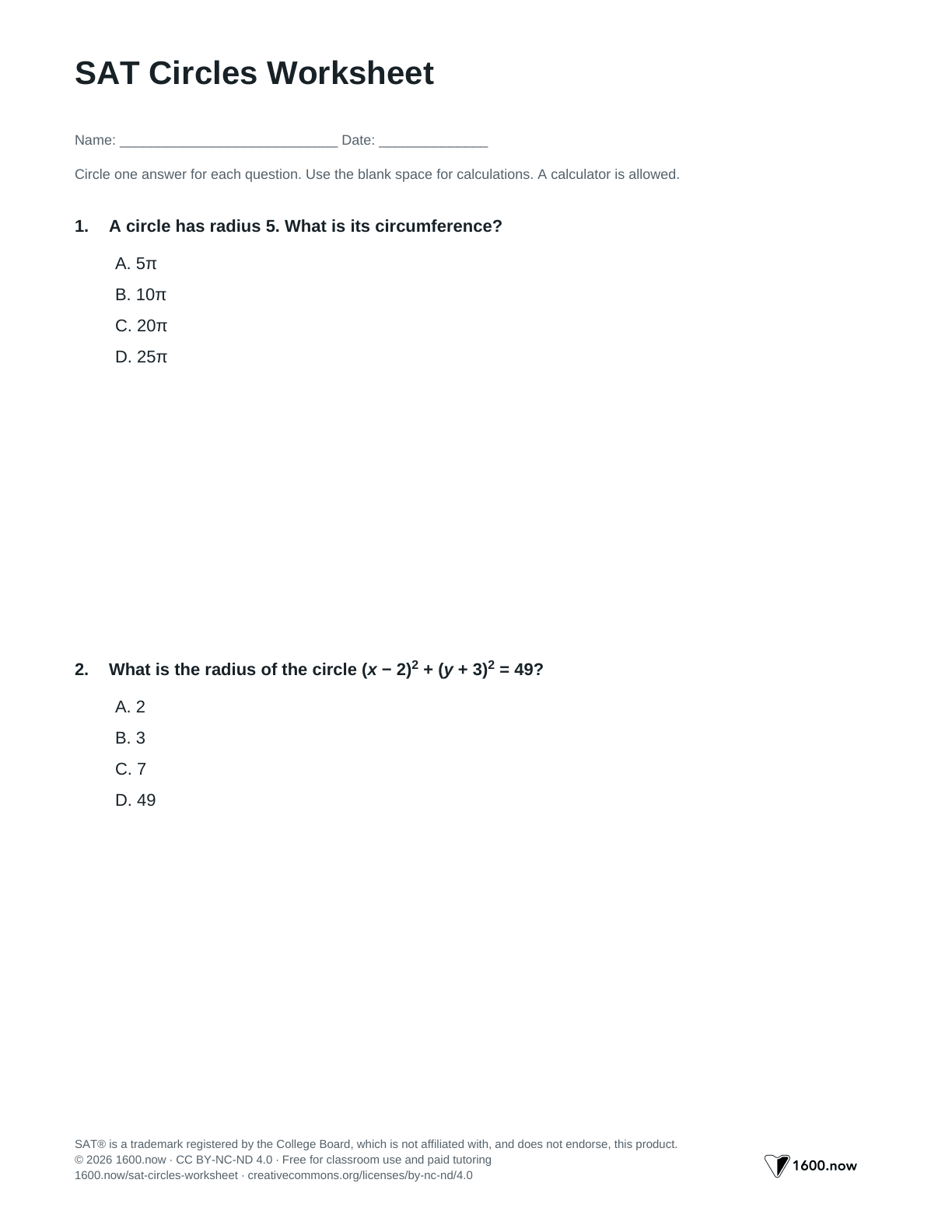
The 12 questions below cover those circle rules, completing the square, and the right angle between a tangent and its radius. Download the student PDF to work without answers, or choose the explained answer-key version. Both come in Letter and A4.
12 questions · about 25 minutes · Geometry and Trigonometry › Circles
Share to Google Classroom · This worksheet is free to print and share under CC BY-NC-ND 4.0. Tutors may also use it in paid sessions. If you post it online, please link to this page instead of re-uploading the PDF. These are original questions, not College Board items.
Circle rules to write before calculating
In , the center is and the radius is . Match each expression to the subtraction in the standard equation, then take the positive square root of the right side. The diameter is twice that radius.
An arc is part of a circumference; a sector is part of an area. For a central angle of degrees, arc length is and sector area is . A 90-degree piece uses one fourth of the relevant whole.
A radius to a point of tangency is perpendicular to the tangent line. Mark that 90-degree angle before using another triangle rule. When the equation is expanded, complete both squares and add the same amounts to the other side; the worked example below shows each addition.
Try it yourself
Choose an answer.
Questions
Question 1
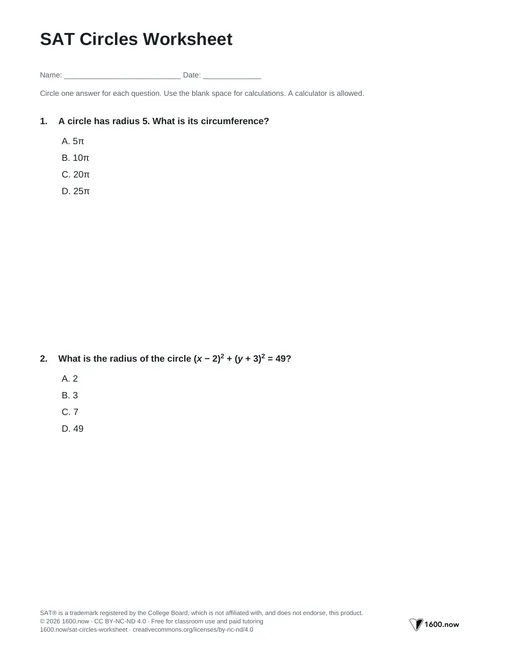
A circle has radius 5. What is its circumference?
B. Circumference is . Substituting gives units.
Question 2
What is the radius of the circle ?
C. The right side is , so the radius is 7. The constants inside the squares locate the center.
Question 3
The circle shown has radius 7. What is its area?
C. Area is . With radius 7, the area is square units.
Question 4
What is the center of ?
A. Compare with . Here and .
Question 5
A 90° central angle intercepts an arc in a circle of radius 8. What is the arc length?
B. The angle covers one quarter of the circle. One quarter of circumference is .
Question 6
A circle has area . What is its diameter?
B. From , . Diameter is twice the radius, so it is 18.
Question 7
What is the radius of ?
C. Complete the squares: . Thus .
Question 8
The shaded sector has central angle 60° and radius 6. What is its area?
B. A 60° sector is one sixth of a circle. Its area is .
Question 9
A line is tangent to a circle at point T. What is the angle between the tangent and the radius ending at T?
D. A radius drawn to a point of tangency is perpendicular to the tangent line, forming a 90° angle.
Question 10
A circle centered at the origin passes through (6, 8). Which equation represents it?
C. The squared radius is the squared distance from the origin: .
Question 11
A circle has circumference . What is its area?
C. From , . Then area = .
Question 12
In a circle with radius 4, a central angle of radians intercepts an arc. What is the length of the arc?
B. Arc length equals times the angle in radians. Here .
0/12 correct
Check your circles answers
Compare your calculation with these specific alternatives. Each row identifies the measurement or algebraic step that produced it and gives a check you can run.
| What your answer looked like | What actually happened | Fix it next time |
|---|---|---|
| A radius of 49 from | That 49 is , not . The equation is built as , so the number sitting on the right is the radius squared. | The radius is 7, because 49 is what you get after squaring it. If your radius matches the number on the right, you skipped the square root. |
| A center of from | Sign flip. The template subtracts the center, so is really , and . | Write the empty template first, then copy each number out with the opposite sign. |
| An area of for a circle of radius 7 | You used the circumference formula. Circumference is and area is , and both values show up as choices, so the swap is easy to make and easy to miss. | Decide before you calculate whether the question wants the distance around the circle or the space inside it. is the trip around; is the area. |
| A diameter of 9 when the area is | You stopped at the radius. gives , and the question asked for the diameter. | Underline the word radius, diameter, circumference, area, arc, or sector before you reach for a formula. Diameter is , so the answer is 18. |
| An arc length of for a 90-degree angle in a circle of radius 8 | That is half the circumference, which is . A 90-degree central angle cuts off one quarter, not one half. | Multiply the full measurement by the fraction of the circle you actually have. A quarter of the circumference is . |
| A sector area of for a 60-degree sector of a circle with radius 6 | That is half the correct sector area. The arc length would be , so is not the arc length either. Apply the 60-degree fraction to the circle’s area. | Take the same fraction of the area instead. A 60-degree sector is one sixth of the circle, so its area is . |
| 30 degrees or 60 degrees at the point where a line touches a circle | Nothing in the diagram sets that angle, so there's nothing to estimate. A radius drawn to the point of tangency is perpendicular to the tangent line. | Treat the tangent-radius angle as a fact: 90 degrees every time, no matter how the picture is drawn. |
Worked example: the completing-the-square question
One question on the sheet hands you a circle in general form, , and asks for the radius. There's no center to read off and no radius squared waiting on the right, so you have to build both. Group the x-terms and complete that square: becomes once you add 9. Do the same for the y-terms: becomes once you add 4. Add the same amounts to the right side: .
The equation now reads , so the center is and , which makes the radius 5. A radius of 12 reads the original right side as the radius before completing the squares. A radius of 25 stops at the new right side, which is the radius squared. Take its positive square root to get 5.
Apply the check to fresh questions
For fresh circles questions, use the practice link below. Label the requested quantity before calculating, then check whether the answer should have length units or square units.