
SAT Area and Volume Worksheet
Area measures a two-dimensional region; volume measures a three-dimensional space. Label the requested units before choosing a formula. A length scale factor changes area by its square and volume by its cube.

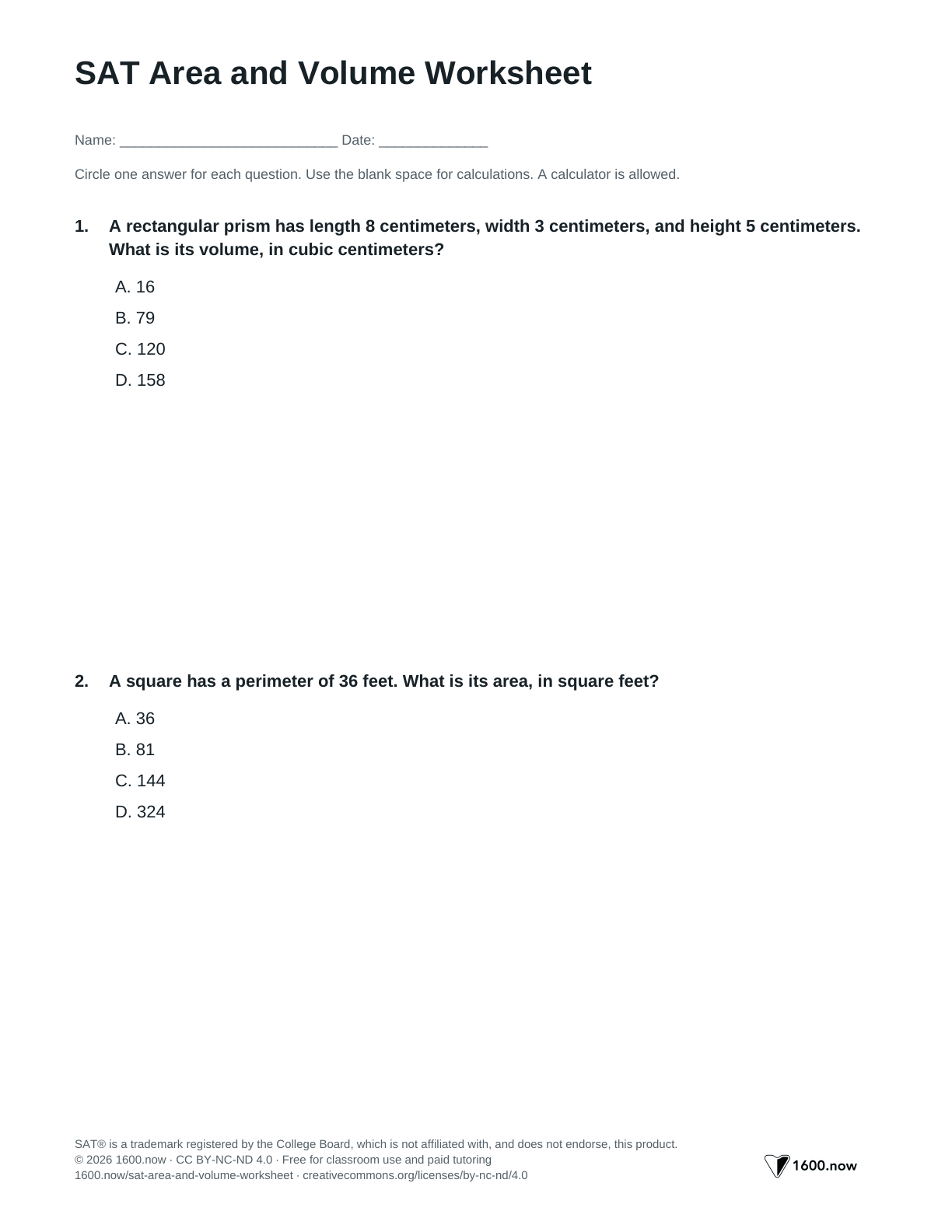
The 12 questions include composite shapes, prisms, cylinders, cones, spheres, conversions, and displacement. Download a student worksheet or the PDF with explanations.
12 questions · about 25 minutes · Geometry and Trigonometry › Area and volume
Share to Google Classroom · This worksheet is free to print and share under CC BY-NC-ND 4.0. Tutors may also use it in paid sessions. If you post it online, please link to this page instead of re-uploading the PDF. These are original questions, not College Board items.
Match the dimensions, formula, and units
For a rectangular prism, . For a cylinder, ; for a cone, . The radius is the dimension squared. Surface area measures the outer faces and answers a different question.
For a composite region, divide it into nonoverlapping shapes or subtract a missing region from a larger shape. Label every needed length from the diagram. Use a second decomposition to check that nothing is omitted or counted twice.
A conversion of lengths must be squared for area or cubed for volume. One square yard is square feet. Similarly, doubling all dimensions gives four times the area and eight times the volume.
For displacement in a tank with a constant cross-section, divide displaced volume by base area to find the rise. Cubic units divided by square units leave length units, which checks the setup.
Try it yourself
Choose an answer.
Questions
Question 1
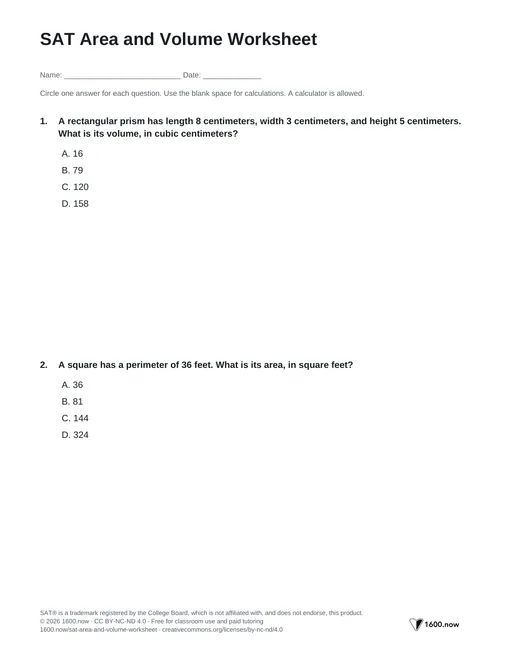
A rectangular prism has length 8 centimeters, width 3 centimeters, and height 5 centimeters. What is its volume, in cubic centimeters?
C. The volume of a rectangular prism is length times width times height: . Choice D, 158, is the surface area.
Question 2
A square has a perimeter of 36 feet. What is its area, in square feet?
B. Each side is feet, so the area is square feet. Choice A is the perimeter.
Question 3
The right circular cylinder shown has radius 3 and height 10. What is its volume?
B. Volume is . Choice C uses 10 as the radius and 3 as the height.
Question 4
A cube has a volume of 64 cubic inches. What is its surface area, in square inches?
C. The edge length is 4 inches because . Each of the 6 faces has area 16 square inches, so the surface area is square inches. Choice D multiplies the volume by 6.
Question 5
The rectangular box shown has a volume of 360 cubic inches. The dimensions are in inches. What is the value of ?
A. Volume is length times width times height, so . Then and . Choice C divides 360 by 12 only.
Question 6
The figure shows the floor plan of a room. All corners are right angles, and the lengths are in meters. What is the area of the floor, in square meters?
D. Split the floor into a 10-by-5 rectangle and a 6-by-3 rectangle above it: square meters. As a check, the missing corner is 4 by 3, and .
Question 7
A rectangular patio measures 6 yards by 4 yards. What is its area, in square feet? (1 yard = 3 feet)
D. Convert first: the patio is 18 feet by 12 feet, so its area is square feet. Choice B multiplies 24 square yards by 3, but 1 square yard is 9 square feet.
Question 8
A right circular cone has radius 6 centimeters and height 5 centimeters. What is its volume, in cubic centimeters?
C. The volume of a cone is . Choice D leaves out the .
Question 9
Rectangle B is similar to rectangle A, and each side of rectangle B is 3 times as long as the corresponding side of rectangle A. The area of rectangle A is 12 square units. What is the area of rectangle B, in square units?
D. Multiplying every length by 3 multiplies the area by . The area of rectangle B is square units. Choice A multiplies the area by 3 instead of 9.
Question 10
A sphere has a volume of cubic centimeters. What is the radius of the sphere, in centimeters?
A. Set . Then , so . Choice D is , not .
Question 11
Cylinder A has radius and height . Cylinder B has radius and height . The volume of cylinder B is how many times the volume of cylinder A?
B. The volume of cylinder B is , which is 2 times the volume of cylinder A. Doubling the radius multiplies the volume by 4, and halving the height divides it by 2.
Question 12
A rectangular tank has a base 50 centimeters long and 40 centimeters wide and is partly filled with water. A solid cube with 10-centimeter edges is placed in the tank, where it sinks and is completely covered by the water. No water spills. By how many centimeters does the water level rise?
A. The cube pushes aside cubic centimeters of water, which spreads over the base area of square centimeters. Dividing 1,000 by 2,000 gives a rise of 0.5 centimeter. Choice C divides the base area by the volume instead.
0/12 correct
Check your area and volume answers
Each row is a wrong answer choice from one of the sheet's problems. Find the one you picked, then run the check in the last column.
| What your answer looked like | What actually happened | Fix it next time |
|---|---|---|
| 158 in problem 1 | 158 is the surface area, . The question asks for the volume. | Volume multiplies the three dimensions: cubic centimeters. |
| in problem 3 | You swapped the radius and the height. The radius is the one that gets squared. | . |
| 48 in problem 6 | covers only the tall left part of the room and leaves out the 4-by-5 section on the right. | Split the floor into two rectangles, and , for a total of 68. Check: . |
| 72 in problem 7 | You multiplied 24 square yards by 3. One square yard is 3 feet by 3 feet, or 9 square feet. | Convert the lengths before you multiply: 18 feet by 12 feet is 216 square feet. Converting the area gives the same answer: . |
| in problem 8 | That's the volume of a cylinder with the same radius and height. A cone holds one third as much. | . |
| 36 in problem 9 | You multiplied the area by 3. Each side is 3 times as long, and area has two dimensions, so the area grows by . | The area is square units. Check with a 3-by-4 rectangle, area 12: tripling the sides gives 9 by 12, area 108. |
Worked example: the rising water level
Problem 12 drops a solid cube with 10-centimeter edges into a tank whose base is 50 by 40 centimeters. The cube ends up completely underwater, so it pushes aside its whole volume of water: cubic centimeters.
That water spreads over the whole base of the tank, square centimeters. The rise is the volume divided by the base area: centimeter. The units check out, since cubic centimeters divided by square centimeters leaves centimeters. The choice 2 divides the other way, and 10 is the cube's edge.
Apply the check to fresh questions
Keep square or cubic units in your next calculation and check the final dimensions. Use the area-and-volume practice link for another diagram or scale-factor question.
Review the area and volume method