
SAT Rhetorical Synthesis Worksheet
Read the writing goal before the notes. A correct rhetorical synthesis answer uses accurate information to do exactly what that goal asks, such as comparing lengths, explaining a cause, or naming a similarity.

The 12 student-notes questions below include true statements that fail the requested goal. Choose a student PDF for practice without answers or download the full version with explanations.
12 questions · about 25 minutes · Expression of Ideas › Rhetorical Synthesis
Share to Google Classroom · This worksheet is free to print and share under CC BY-NC-ND 4.0. Tutors may also use it in paid sessions. If you post it online, please link to this page instead of re-uploading the PDF. These are original questions, not College Board items.
Turn the goal into an answer requirement
Identify the action and the subject of the goal. "Compare the lengths" requires both lengths; a correct comparison of opening dates does not satisfy it. "Explain why" requires a cause connected to its result.
Mark only the notes needed for that requirement. For a similarity, find a shared feature. For a difference, choose the same measurement for both items. Background about a scientist’s name or sample locations can be accurate without answering why a method works.
Test the sentence twice: first against the notes for accuracy, then against the goal for relevance. Keep all requested parts. A goal asking for a similarity and a difference needs both in the chosen answer.
Try it yourself
Choose an answer.
Questions
Question 1
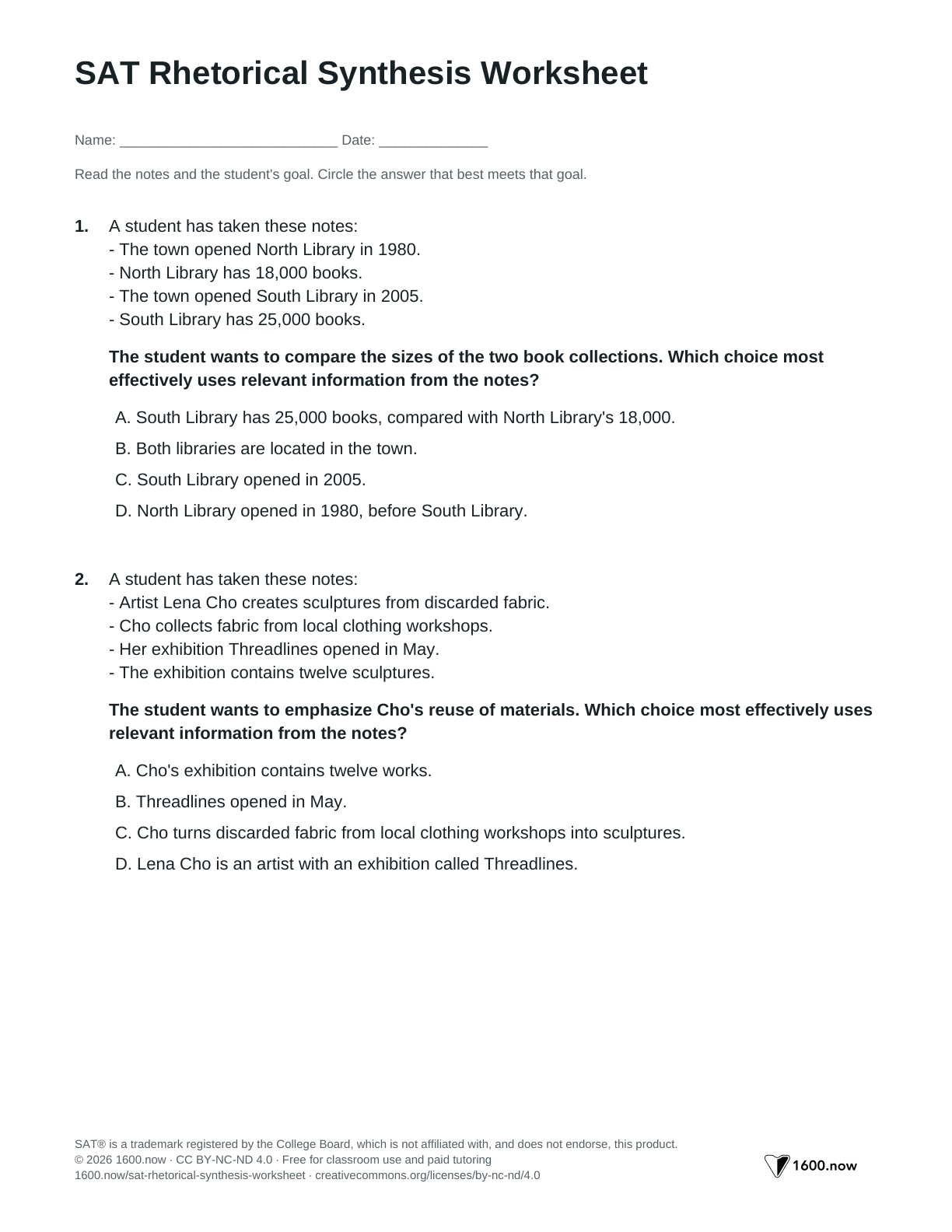
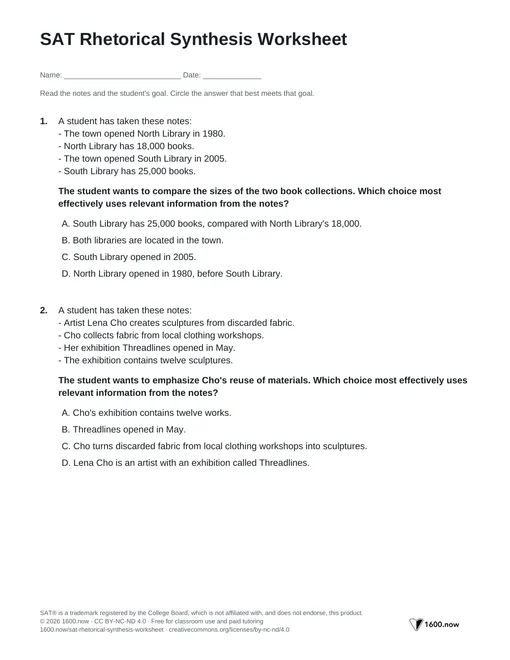
A student has taken these notes: - The town opened North Library in 1980. - North Library has 18,000 books. - The town opened South Library in 2005. - South Library has 25,000 books.
The student wants to compare the sizes of the two book collections. Which choice most effectively uses relevant information from the notes?
A. The correct answer directly compares collection sizes with the relevant counts. The other statements concern dates or location, not the requested comparison.
Question 2
A student has taken these notes: - Artist Lena Cho creates sculptures from discarded fabric. - Cho collects fabric from local clothing workshops. - Her exhibition Threadlines opened in May. - The exhibition contains twelve sculptures.
The student wants to emphasize Cho's reuse of materials. Which choice most effectively uses relevant information from the notes?
C. The discarded source material and its transformation into sculptures directly establish reuse. The title, opening month, and count do not accomplish that goal.
Question 3
A student has taken these notes: - Two sensors measure air temperature. - Sensor A weighs 40 grams. - Sensor B weighs 75 grams. - Both sensors record a reading every minute.
The student wants to identify a similarity between the sensors. Which choice most effectively uses relevant information from the notes?
D. The common recording interval gives a similarity. The other choices emphasize differences or describe only one sensor.
Question 4
A student has taken these notes: - A local history project recorded interviews with longtime residents. - Volunteers transcribed the recordings. - The transcripts are searchable online. - The project began in 2022.
The student wants to explain how readers can locate a specific topic in the interviews. Which choice most effectively uses relevant information from the notes?
B. Searchable online transcripts directly explain how to locate a topic. The other choices provide background but no method.
Question 5
A student has taken these notes: - Researcher Maya Patel studies coastal erosion. - Patel uses photographs taken from fixed observation points. - Repeating photographs from the same points helps reveal changes in the shoreline. - The project includes six beaches.
The student wants to explain the purpose of using fixed observation points. Which choice most effectively uses relevant information from the notes?
A. The correct answer explains why consistent observation locations are useful: they reveal changes over time. The other choices state the topic or scope without explaining the method's purpose.
Question 6
A student has taken these notes: - The novel The Open Gate was published in 1912. - It follows a family moving from a farm to a city. - A stage adaptation premiered in 1930. - The adaptation preserves the family's move but removes several minor characters.
The student wants to describe both a similarity and a difference between the novel and the adaptation. Which choice most effectively uses relevant information from the notes?
C. The correct answer includes the shared central event and the changed cast. The other choices give information about only one version or omit the required comparison.
Question 7
A student has taken these notes: - The Alder Bridge opened in 1920. - It spans 80 meters. - The Cedar Bridge opened in 1975. - It spans 140 meters.
The student wants to compare the bridge lengths. Which choice most effectively uses relevant information from the notes?
C. The requested comparison is length, so both spans are relevant. Opening dates do not accomplish that goal.
Question 8
A student has taken these notes: - Scientist Nora Lee studies pollen preserved in lake sediment. - Different plant species produce distinctive pollen. - Pollen in older sediment can identify plants that lived nearby in the past. - Lee collected samples from four lakes.
The student wants to explain why ancient pollen is useful to Lee. Which choice most effectively uses relevant information from the notes?
D. The answer connects distinctive pollen to identifying past plants, explaining the method's usefulness rather than just its location or researcher.
Question 9
A student has taken these notes: - The play Harbor Lights premiered in 1990. - Its author later adapted it into a novel. - The novel was published in 1998. - Both versions follow a family running a ferry service.
The student wants to identify a similarity between the versions. Which choice most effectively uses relevant information from the notes?
A. The family and ferry service are shared by both versions. The other choices establish chronology or describe only one version.
Question 10
A student has taken these notes: - A team tested two insulating materials. - Material P costs $4 per square meter. - Material Q costs $7 per square meter. - Under the test conditions, both reduced heat loss by the same amount.
The student wants to emphasize a cost advantage of Material P. Which choice most effectively uses relevant information from the notes?
B. The lower cost and equal tested performance establish P's advantage. The answer does not claim equal performance under every possible condition.
Question 11
A student has taken these notes: - A museum is cataloging a collection of woven baskets. - Each basket is photographed from several angles. - Multiple views document patterns hidden on the underside. - The collection contains 60 baskets.
The student wants to explain the purpose of taking multiple photographs. Which choice most effectively uses relevant information from the notes?
C. The multiple angles reveal otherwise hidden patterns. That explains the procedure's purpose; the collection size does not.
Question 12
A student has taken these notes: - An urban orchard planted three apple varieties. - Each variety ripens in a different month. - Staggered ripening extends the harvest period. - Volunteers maintain the orchard.
The student wants to explain why planting several varieties lengthens the harvest. Which choice most effectively uses relevant information from the notes?
D. The answer states the causal link between different ripening times and an extended harvest. Merely counting varieties does not explain the result.
0/12 correct
Check your rhetorical synthesis answers
Each row is a wrong answer choice from one of the sheet's problems. All of them are true to the notes; the middle column says what the goal needed instead.
| What your answer looked like | What actually happened | Fix it next time |
|---|---|---|
| “Lena Cho is an artist with an exhibition called Threadlines” in problem 2 | It would work as an introduction, but the goal is to emphasize Cho's reuse of materials, and this sentence never mentions discarded fabric. | Find the note that names the reused material, then pick the choice built on it: Cho turns discarded fabric from local clothing workshops into sculptures. |
| “The two sensors differ in weight by 35 grams” in problem 3 | The math is right, , but the goal asks for a similarity, and a difference in weight is the opposite. | Check the goal word before the facts. A similarity is something both sensors share: each records temperature once per minute. In problem 9, the eight years between the play and the novel are a difference too. |
| “The Open Gate is a novel about a family” in problem 6 | This describes only the novel. The goal asks for a similarity and a difference between the novel and the stage adaptation. | When the goal names two things, the answer has to mention both. Both versions follow a family's move to a city, but the adaptation omits several minor characters. |
| “The Alder Bridge opened before the Cedar Bridge” in problem 7 | It does compare the two bridges, but by opening date. The goal asks you to compare their lengths. | Circle the noun in the goal, here length, and pick the choice that gives both lengths: 140 meters and 80 meters. Problem 1 works the same way with 25,000 and 18,000 books. |
| “Material P and Material Q were tested under the same conditions” in problem 10 | True, and it's why the comparison is fair, but it never mentions cost. The goal is to emphasize a cost advantage of Material P. | An advantage needs the result and the comparison together: P reduced heat loss as much as Q in the test, at a lower cost per square meter. |
| “Three varieties were planted in the orchard” in problem 12 | It counts the varieties without saying why they lengthen the harvest. A goal that asks you to explain why needs the cause. | Find the note that gives the cause: each variety ripens in a different month. The answer links that cause to the result, a longer harvest. |
Worked example: matching the notes to the goal
In problem 8, the notes say four things about Nora Lee's work, and the goal is to explain why ancient pollen is useful to her. Before you read the choices, find the notes that answer why: different plant species produce distinctive pollen, and pollen in older sediment can identify plants that lived nearby in the past. The other two notes, that Lee studies pollen in lake sediment and that she collected samples from four lakes, are true but give no reason.
Now read the choices. “Lee collected samples from four lakes” and “Nora Lee is a scientist who studies pollen” each repeat a note you set aside. “Lee studies pollen preserved in sediment from four lakes” joins those two notes into one sentence and still doesn't say why. Only the choice about distinctive pollen in old sediment helping Lee identify plants that once grew near a lake uses the notes that answer the goal.
Apply the check to fresh questions
On the next notes question, underline the goal’s action and measurement before reading the facts. Then use the Rhetorical Synthesis practice link to apply that requirement to fresh notes.
Review the rhetorical synthesis method