
SAT Main Idea and Details Worksheet
A main idea answer captures the point of the whole passage. A detail answer reports the specific fact the question requests. Write a short summary for the first kind; locate the relevant sentence for the second.

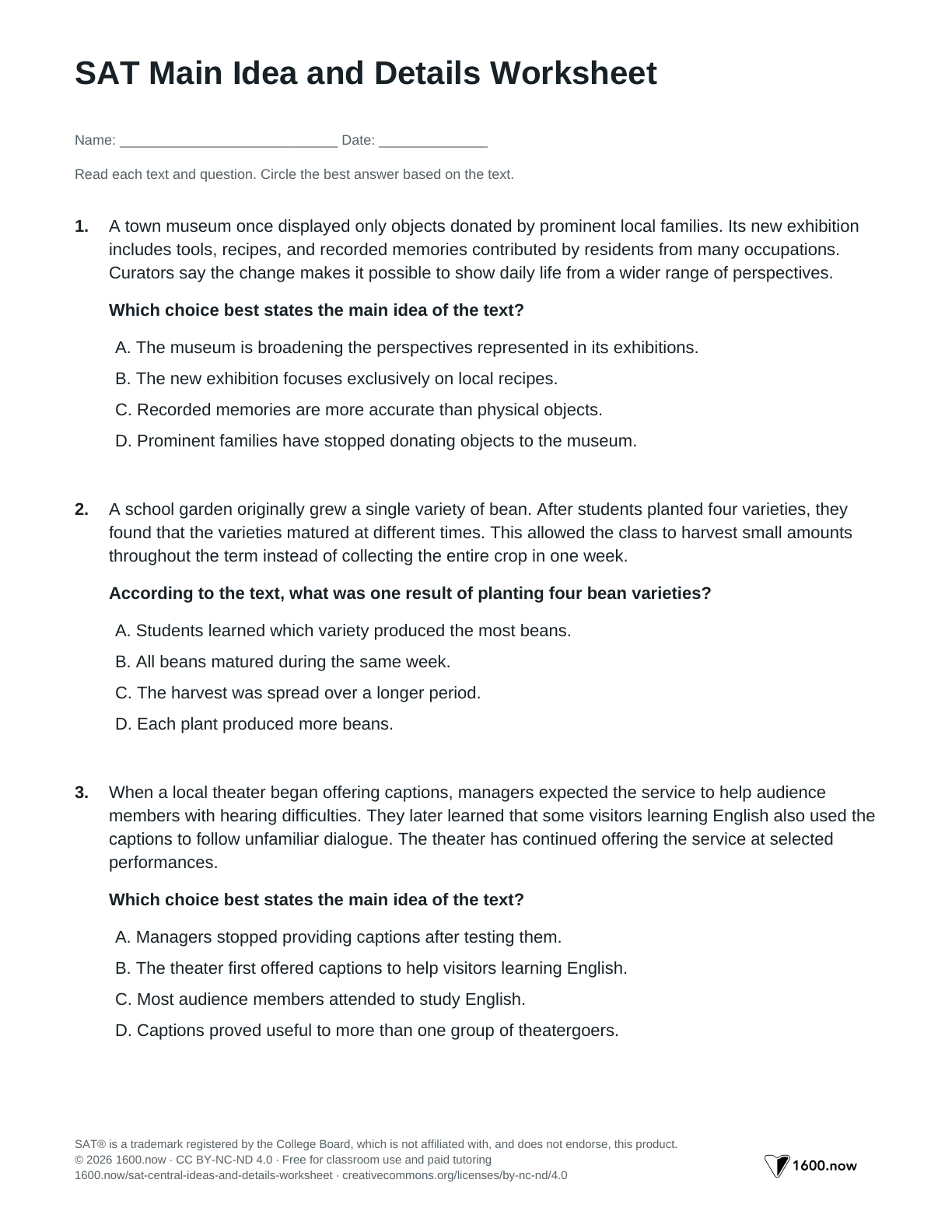
The worksheet has six main-idea questions and six detail questions. Answer all 12 on screen or download a student PDF and an explained answer key in Letter or A4.
12 questions · about 25 minutes · Information and Ideas › Central Ideas and Details
Share to Google Classroom · This worksheet is free to print and share under CC BY-NC-ND 4.0. Tutors may also use it in paid sessions. If you post it online, please link to this page instead of re-uploading the PDF. These are original questions, not College Board items.
Keep the summary broad enough and the detail exact
For the main idea, ask what changed, what was learned, or what the author is explaining. Keep the subject and the central claim together. "A museum" names a subject; "a museum expanded whose daily life its exhibits represent" captures a point.
Check your summary against every sentence. An example should support it, while a qualification should still fit inside it. A choice built around one item from a list can miss the point that connects the list.
For a detail question, use the exact part of the passage that answers what, why, or when. Preserve sequence words such as initially and later. Do not turn a reported description into a preference or a planned audience into the actual audience.
Try it yourself
Choose an answer.
Questions
Question 1
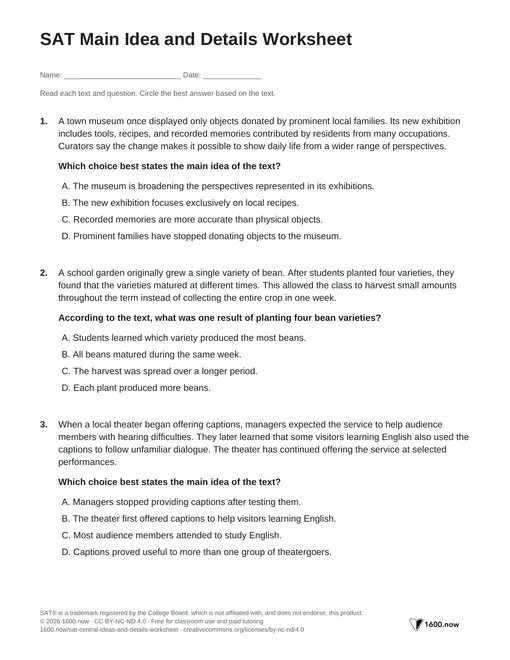
A town museum once displayed only objects donated by prominent local families. Its new exhibition includes tools, recipes, and recorded memories contributed by residents from many occupations. Curators say the change makes it possible to show daily life from a wider range of perspectives.
Which choice best states the main idea of the text?
A. The shift from prominent-family donations to many kinds of residents supports a broader representation of daily life. The other choices introduce unsupported claims or narrow the exhibition to one item type.
Question 2
A school garden originally grew a single variety of bean. After students planted four varieties, they found that the varieties matured at different times. This allowed the class to harvest small amounts throughout the term instead of collecting the entire crop in one week.
According to the text, what was one result of planting four bean varieties?
C. Because the varieties matured at different times, the class could harvest throughout the term. The text never compares how many beans the varieties or the plants produced.
Question 3
When a local theater began offering captions, managers expected the service to help audience members with hearing difficulties. They later learned that some visitors learning English also used the captions to follow unfamiliar dialogue. The theater has continued offering the service at selected performances.
Which choice best states the main idea of the text?
D. Captions helped the people they were meant for, audience members with hearing difficulties, and also some visitors learning English. The English learners were a later discovery, and nothing says they were most of the audience.
Question 4
An artist collected discarded window glass for a series of sculptures. Rather than polishing away the scratches, she positioned each piece so that light emphasized the marks. She wanted viewers to notice the material's earlier use as well as its new form.
Why did the artist emphasize the scratches?
B. The artist wanted viewers to notice the glass's earlier use, and the scratches show that history. She used light to bring out the marks, not to brighten the work or hide flaws.
Question 5
A city tested two ways to announce changes to bus routes: notices at stops and alerts in a mobile app. Interviews showed that some riders relied on the notices, while others checked only the app. Transit staff concluded that retaining both methods would reach more riders than choosing either method alone.
Which choice best states the main idea of the text?
A. Staff kept both methods because some riders read the notices and others check only the app. Dropping either method, or calling one always better, goes against that conclusion.
Question 6
Researchers comparing two editions of a novel found that the later edition shortened several descriptions but preserved the sequence of events. They argued that the revisions changed the pace of the narrative without changing its basic plot.
Which detail supports the researchers' distinction between pace and plot?
C. Shorter descriptions change the pace, and the unchanged order of events shows the plot stayed the same. A shorter edition says nothing about plot, and choices B and D contradict the text.
Question 7
Volunteers digitizing a newspaper archive noticed that the same street sometimes appeared under different spellings. They created a search index linking those variants. Readers could then find articles about the street without knowing every spelling used in the archive.
Which choice best states the main idea of the text?
A. The index links the different spellings, so readers can find articles about the street under any of them. The volunteers didn't edit the articles, and nothing says any street was renamed.
Question 8
A researcher placed temperature sensors on both sides of a stone wall. She took readings at sunrise and again at midday, repeating the procedure on five clear days. She excluded rainy days to avoid mixing observations made under different weather conditions.
Why did the researcher exclude rainy days?
B. The last sentence gives the reason: she didn't want to mix observations made in different weather. The text never says the sensors failed in rain, and leaving out rainy days means she wasn't studying rain.
Question 9
A publisher began releasing large-print editions of several novels. Demand came not only from readers with limited vision but also from readers who found larger type more comfortable during long reading sessions. The publisher added more titles to the series.
Which choice best states the main idea of the text?
C. Readers with limited vision and readers who wanted comfort during long sessions both bought the editions. The text doesn't say the series was designed for either group or that it replaced other formats.
Question 10
A survey of neighborhood gardens found that gardeners shared seeds more often with people they had met at local events than with people known only through an online forum. The survey recorded exchanges but did not measure how much food the gardens produced.
Which information did the survey collect?
D. The survey recorded who shared seeds with whom and how the gardeners knew each other. It did not measure food production, and it says nothing about planting amounts or which events people attended.
Question 11
A pianist tested two arrangements of the same piece. One gave the melody to the highest notes throughout; the other moved it between high and low registers. Listeners recognized the tune in both, but many described the second arrangement as more varied.
Which choice best states the main idea of the text?
A. Listeners recognized the tune in both arrangements, and many heard the second as more varied. Calling an arrangement more varied is not the same as preferring it.
Question 12
To reduce accidental damage, a library replaced a display of fragile originals with high-resolution reproductions. The originals remained available to researchers by appointment in a supervised room.
What happened to the original documents?
B. The text says researchers could still examine originals by appointment in a supervised room. Removing them from the public display did not eliminate access.
0/12 correct
Check your main idea answers
Each row is a wrong answer choice from one of the sheet's problems, with the sentence in the passage that rules it out.
| What your answer looked like | What actually happened | Fix it next time |
|---|---|---|
| “The new exhibition focuses exclusively on local recipes” in problem 1 | Recipes are one of three things residents contributed, along with tools and recorded memories. A choice built on one item from a list is too narrow to be the main idea. | Check a main idea choice against every sentence. The last sentence gives the point: the change lets the museum show daily life from a wider range of perspectives. |
| “The theater first offered captions to help visitors learning English” in problem 3 | That reverses the order. Managers expected the captions to help audience members with hearing difficulties, and only later learned that visitors learning English used them too. | Mark the time words expected and later. One group was planned for and one was discovered, so the main idea is that captions proved useful to more than one group of theatergoers. |
| “Mobile alerts reached every rider in the city” in problem 5 | Interviews found that some riders relied on the notices at stops. If the app had reached everyone, staff wouldn't need to keep both methods. | Test words like every, always, and only against the passage. Staff kept both methods because together they reach more riders than either one alone. “Notices at bus stops are always more effective than apps” fails the same test. |
| “The sensors could not operate in wet weather” in problem 8 | The passage never mentions the sensors failing. Its last sentence gives the reason: she excluded rainy days “to avoid mixing observations made under different weather conditions.” | When a question asks why, find the sentence with to or because before you read the choices. Here it points to observations taken under comparable weather conditions. |
| “The total harvest weight from every garden” in problem 10 | The last sentence says the survey did not measure how much food the gardens produced. | Find what the survey did record. The first sentence compares whom gardeners shared seeds with, so the survey collected whether and with whom they exchanged seeds. |
| “Listeners preferred the second arrangement to the first” in problem 11 | Many listeners described the second arrangement as more varied. That describes how it sounded, not which one they liked better. | Hold each choice to the passage's own words. Listeners recognized the tune in both versions and heard the second as more varied, so an arrangement can change how varied a piece sounds while keeping its tune. |
Worked example: summarizing before you read the choices
Problem 9 is about a publisher's large-print novels. Before you look at the choices, sum up the passage in one sentence of your own: readers with limited vision bought the books, so did readers who wanted larger type for long reading sessions, and the publisher added more titles. The main idea has to include both groups of readers.
Now test each choice against that summary. “Only readers with limited vision bought large-print books” drops the second group, which the passage adds with “not only” and “but also.” “The publisher designed the series mainly for people who read for long periods” turns buyers into an intended audience; the passage says who bought the books, not whom they were designed for. Nothing in the passage says large print replaced every other format. The remaining choice, that the editions attracted readers with different reasons for preferring larger type, matches the summary.
Apply the check to fresh questions
Summarize another passage in one sentence, then label the question main idea or detail. Use the practice link to check that you can apply the appropriate method to each.
Review the central ideas and details method