
SAT Percentages Worksheet
A percentage is measured relative to a base. For a percent change, use the original value as that base. For successive changes, multiply their factors rather than adding or subtracting the stated percentages.

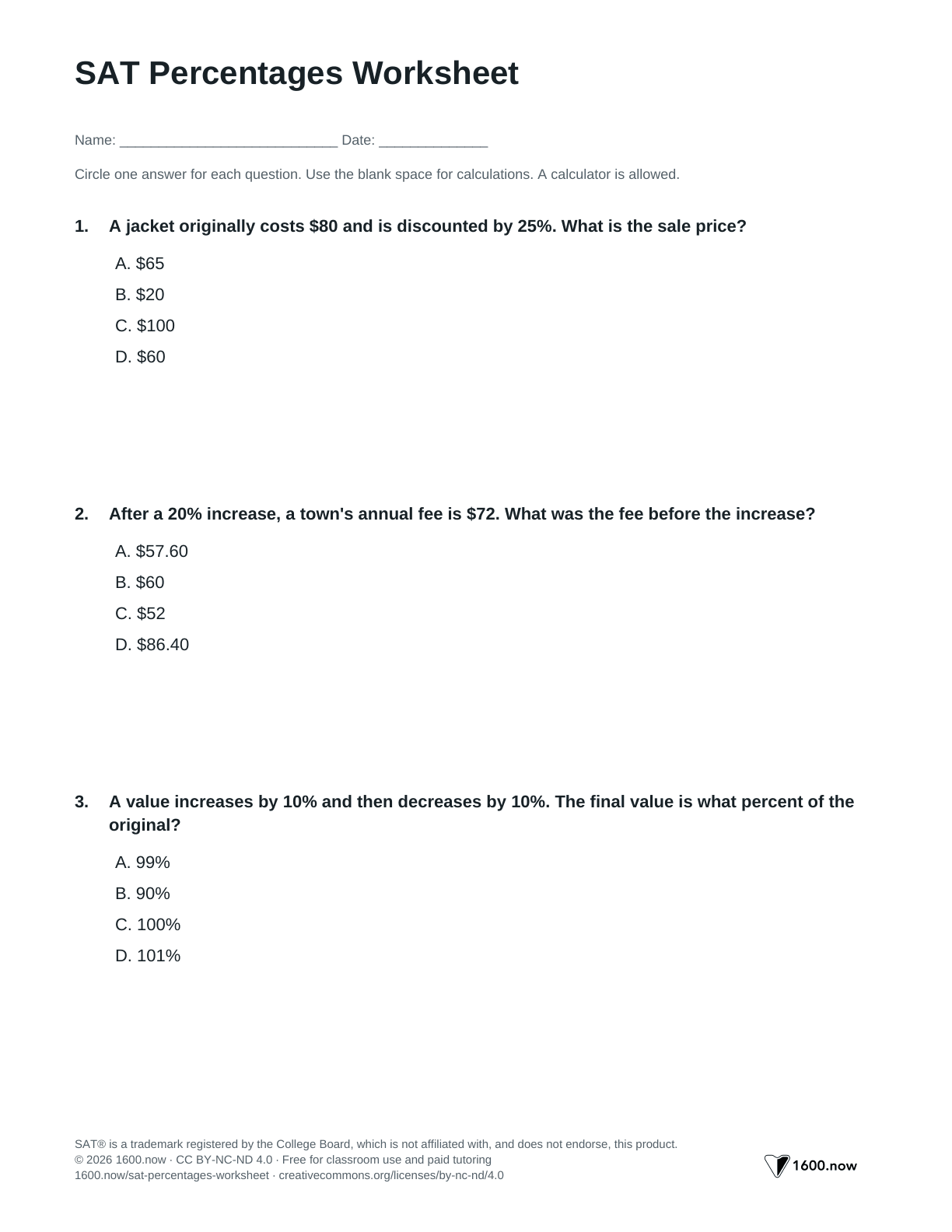
The 12 questions cover discounts, reverse percentages, comparisons, and percentage points. Download the student worksheet or the explained answer-key version in Letter or A4.
12 questions · about 25 minutes · Problem-Solving and Data Analysis › Percentages
Share to Google Classroom · This worksheet is free to print and share under CC BY-NC-ND 4.0. Tutors may also use it in paid sessions. If you post it online, please link to this page instead of re-uploading the PDF. These are original questions, not College Board items.
Write the base and multiplier first
For a change of , the new amount is the original times for an increase or for a decrease. A 25% discount leaves 75% of the price; the discount itself is a different amount.
For a reverse percentage, divide by the multiplier. If a fee after a 20% increase is 72 dollars, , so the original fee is 60 dollars. Subtracting 20% of 72 uses the wrong base.
Apply successive multipliers to the changing amount. A 10% increase followed by a 10% decrease gives , or 99% of the original. A change from 40% to 50% is ten percentage points, but a 25% increase relative to 40%.
Try it yourself
Choose an answer.
Questions
Question 1
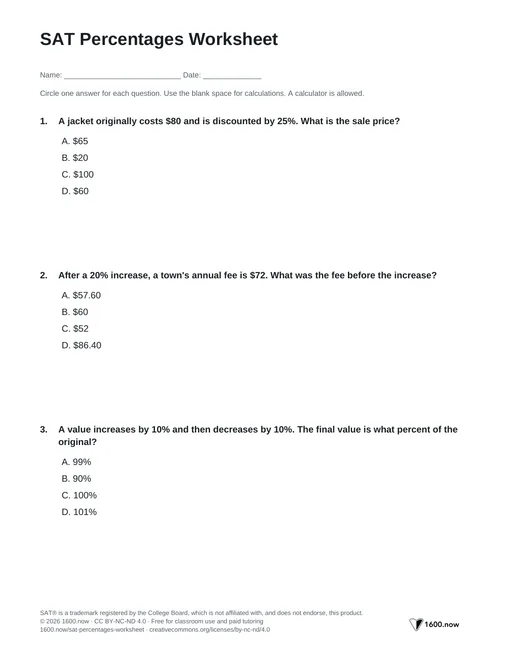
A jacket originally costs $80 and is discounted by 25%. What is the sale price?
D. The remaining price is 75% of $80: . The $20 discount is not the sale price.
Question 2
After a 20% increase, a town's annual fee is $72. What was the fee before the increase?
B. Let the original fee be . Then , so . Subtracting 20% of the new fee uses the wrong base.
Question 3
A value increases by 10% and then decreases by 10%. The final value is what percent of the original?
A. Multiply the change factors: . The result is 99% of the original, a net 1% decrease.
Question 4
Positive quantity A is 150% of positive quantity B. Quantity B is what percent of quantity A?
C. , so . Multiplying by 100% gives .
Question 5
A store's revenue rises from $240,000 to $300,000. What is the percent increase?
B. The increase is $60,000. Divide by the original $240,000: , or 25%.
Question 6
A solution has a total mass of 200 grams, of which 15% is salt. If 100 grams of water is added and no salt is lost, what percent of the new solution's mass is salt?
D. The salt mass stays grams. Total mass becomes 300 grams, so the salt fraction is .
Question 7
A price is reduced by 30% to $84. What was the original price?
C. After a 30% reduction, 70% of the original price remains. Thus , so .
Question 8
A school has 800 students, of whom 35% ride the bus. How many students do not ride the bus?
C. The percentage not riding the bus is . Multiplying 0.65 by 800 gives 520 students.
Question 9
A population increases from 500 to 650. What is the percent increase?
C. The increase is 150, measured against the original 500. Therefore , or 30%.
Question 10
The price of an item rises by 25%. By what percent must the new price decrease to return to the original price?
A. If the original price is 100, the new price is 125. A decrease of 25 from 125 is .
Question 11
A survey reports that support rose from 40% to 50%. What is the relative percent increase in support?
C. The increase is 10 percentage points. Relative to the original 40%, this is ; percentage points and percent change differ.
Question 12
A worker earns $18 per hour and receives a 5% raise. What is the new hourly wage?
C. Multiply the original wage by 1.05: . The increase is $0.90 per hour.
0/12 correct
Check your percentages answers
Each row is a wrong answer choice from one of the sheet's problems. Find the one you picked, then run the check in the last column.
| What your answer looked like | What actually happened | Fix it next time |
|---|---|---|
| $20 in problem 1 or 280 in problem 8 | You found the part that changes: the $20 discount, or the 280 students who ride the bus. Each question asks for what's left. | Use the remaining percent directly: 75% of $80 is $60, and 65% of 800 is 520. |
| $57.60 in problem 2 or $109.20 in problem 7 | You took the percent of the new price. The 20% increase in problem 2 was 20% of the old fee, which you don't know yet. | Write the new price as a multiple of the original: , so . In problem 7, gives . Check: 20% of 60 is 12, and . |
| 100% in problem 3 | A 10% increase and a 10% decrease don't cancel, because the decrease is 10% of a larger number. | Start with 100. Up 10% is 110, and 10% of 110 is 11, so down 10% leaves 99. That's 99% of the original, which matches . |
| 20% in problem 5 or 23% in problem 9 | You divided the change by the new value: and . | Divide by the starting value: and . |
| 25% in problem 10 | The decrease is measured from the new, higher price. A 25% drop from 125 lands at 93.75, not 100. | With an original price of 100, the new price is 125. Getting back to 100 means dropping 25 from 125: . |
| 10% in problem 11 | 10 is the change in percentage points, . The question asks for the relative increase. | Divide the change by the starting percent: . |
Worked example: reversing a percent comparison
Problem 4 says is 150% of and asks what percent is of . Pick a number for to make it concrete. If , then .
Now divide the part by the whole: , or . The choice 50% assumes that since is 50% more than , must be 50% less than . But 50% less than 150 is 75, not 100. The choice 150% answers the question the other way around: as a percent of .
Apply the check to fresh questions
For every percentage answer, write what 100% refers to before calculating. Continue with percentage practice and check reverse problems by applying the stated change to your result.