
SAT Linear Functions Worksheet
A linear function changes by a constant rate. In , is the output change per input unit and is the starting output. Two values determine that rate even when neither input is zero.

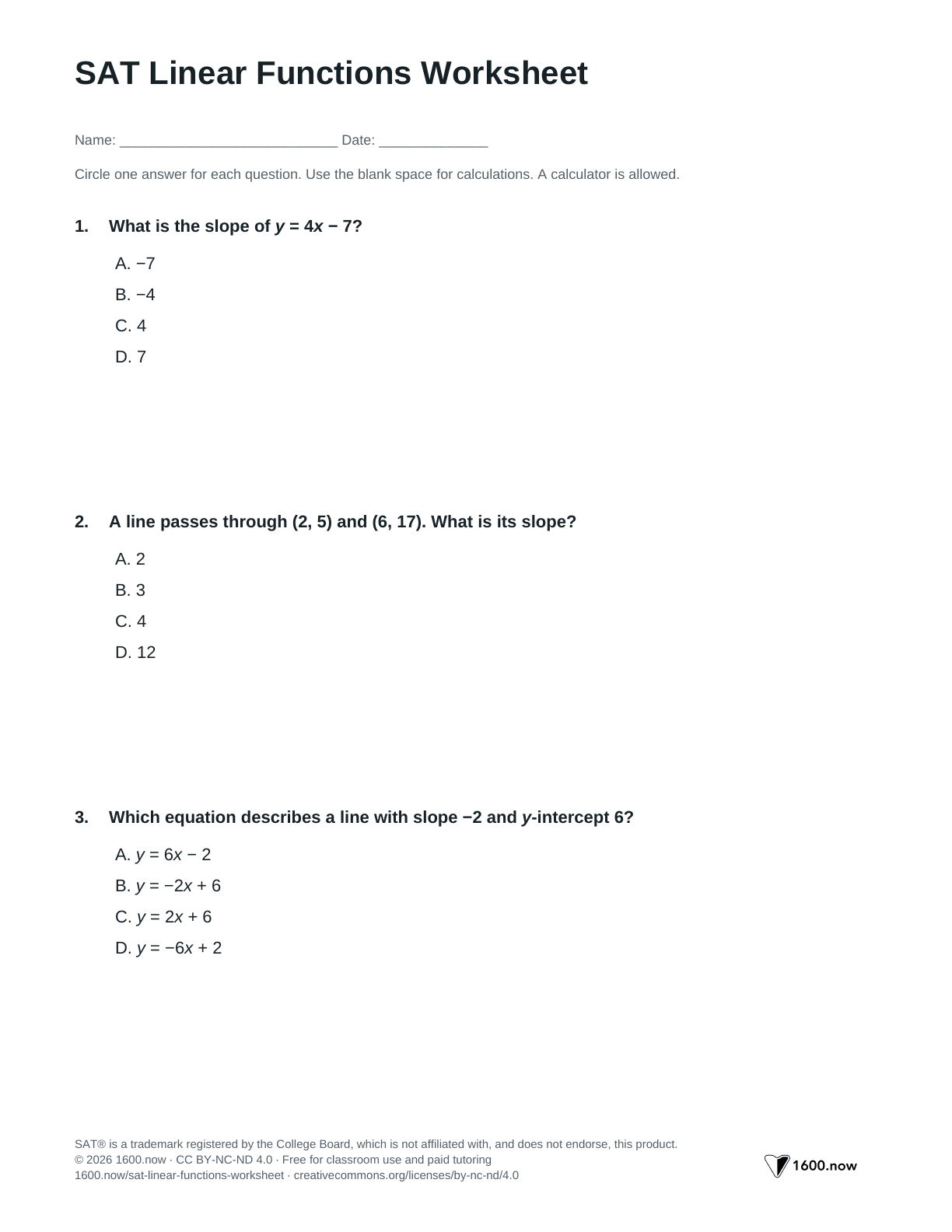
The 12 questions below include slopes, intercepts, tables, and linear word problems. Choose a student PDF or the Letter/A4 version with explained answers.
12 questions · about 25 minutes · Algebra › Linear functions
Share to Google Classroom · This worksheet is free to print and share under CC BY-NC-ND 4.0. Tutors may also use it in paid sessions. If you post it online, please link to this page instead of re-uploading the PDF. These are original questions, not College Board items.
Move from a known value using the rate
Given and , calculate . Keep the subtraction order the same in numerator and denominator. Read the slope in context: liters per minute, dollars per visit, or another output unit per input unit.
You can find a new output directly from a known point: . Going left makes the input change negative. With a negative slope, moving left increases the output.
If you need the equation, substitute a known point into to solve for . A value in the table at is not the intercept. For an -intercept, solve ; for a -intercept, evaluate .
Try it yourself
Choose an answer.
Questions
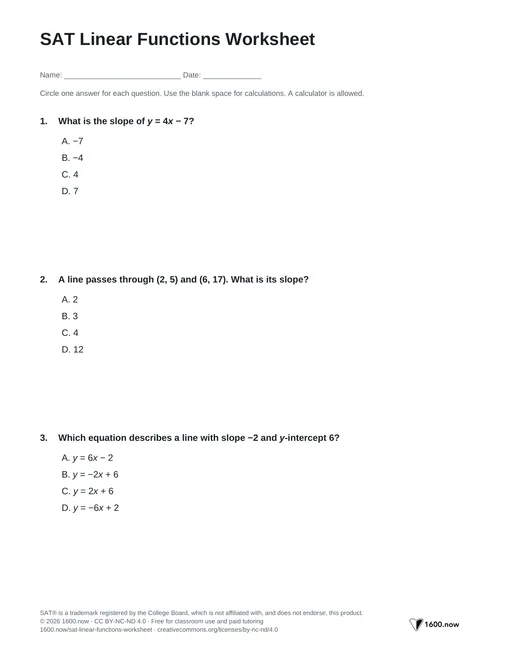
Question 1
What is the slope of ?
C. In slope-intercept form , the coefficient of is the slope. Here the coefficient is 4.
Question 2
A line passes through (2, 5) and (6, 17). What is its slope?
B. Slope is change in divided by change in : .
Question 3
Which equation describes a line with slope −2 and -intercept 6?
B. Substitute and into . The coefficient controls slope and the constant controls the -intercept.
Question 4
A taxi fare, in dollars, is modeled by , where is the number of miles traveled. What does 5 represent in this model?
C. At , . The constant is the starting charge before the distance-based charge is added.
Question 5
If is linear, , and , what is ?
C. The slope is . Moving from to adds , giving 22.
Question 6
What is the -intercept of ?
D. At an -intercept, . Solving gives , so the point is (4, 0).
Question 7
A tank contains 90 liters at time and 66 liters at minutes. If the rate is constant, which model gives the remaining liters?
A. The volume drops 24 liters in 4 minutes, a rate of −6 liters per minute. With initial volume 90, .
Question 8
Which line is parallel to and passes through (1, 9)?
B. A parallel line has slope 5. Substituting (1, 9) gives , so .
Question 9
2 8 4 14 6 20 The table shows values of a linear function. What is ?
C. The output increases by 6 when increases by 2, so the slope is 3. From , subtract 2(3) to get .
Question 10
For , how does change when increases by 8?
A. Multiply the input change by the slope: . The output decreases by 4.
Question 11
A membership costs $24 plus $6 per visit. What is the greatest whole number of visits possible with $90?
B. After the membership fee, $66 remains. At $6 per visit, visits fit the budget.
Question 12
A linear function satisfies and . What is ?
D. The slope is . Moving two units left from increases the output by 4, giving .
0/12 correct
Check your linear functions answers
Each row is a wrong answer choice from one of the sheet's problems. Find the one you picked, then run the check in the last column.
| What your answer looked like | What actually happened | Fix it next time |
|---|---|---|
| 12 or 4 in problem 2 | 12 is the change in and 4 is the change in . The slope is one divided by the other. | . |
| 18 in problem 5 | You added the change in , 2, to . Each 1-unit step in adds the slope, 3. | Two steps from to add , so . Check with : and . |
| for the x-intercept of (problem 6) | That's the y-intercept, where . | An x-intercept has : , so and the point is . |
| in problem 7 | 24 liters is the drop over all 4 minutes. The coefficient of has to be the drop per minute. | liters per minute, so . Check: , while the other model gives . |
| in problem 8 | 9 is the -value at , not at , so it isn't the y-intercept. | Keep the slope 5 and solve for the intercept: , so and the line is . |
| 15 in problem 11 | spends the whole budget on visits and skips the $24 membership fee. | Take the fee out first: , and visits. Check: . |
Worked example: moving along a line from two values
Problem 12 gives and and asks for . Find the slope first: . The output drops 2 for every step to the right.
Going from to is two steps to the left, so the output rises by : . Check with the equation : , , and . The choice is the slope, and it's also what you get by moving the wrong way. The choice 4 is the change in output, and 0 is .
Apply the check to fresh questions
For a fresh linear-function question, attach units to the slope and check a second known point. Then use the practice link for more tables and models.
Review the linear functions method