
SAT Inference Worksheet
An inference is a conclusion supported by the passage, including its limits. Choose the answer that follows from the stated evidence without adding a cause, motive, or universal claim the text never establishes.

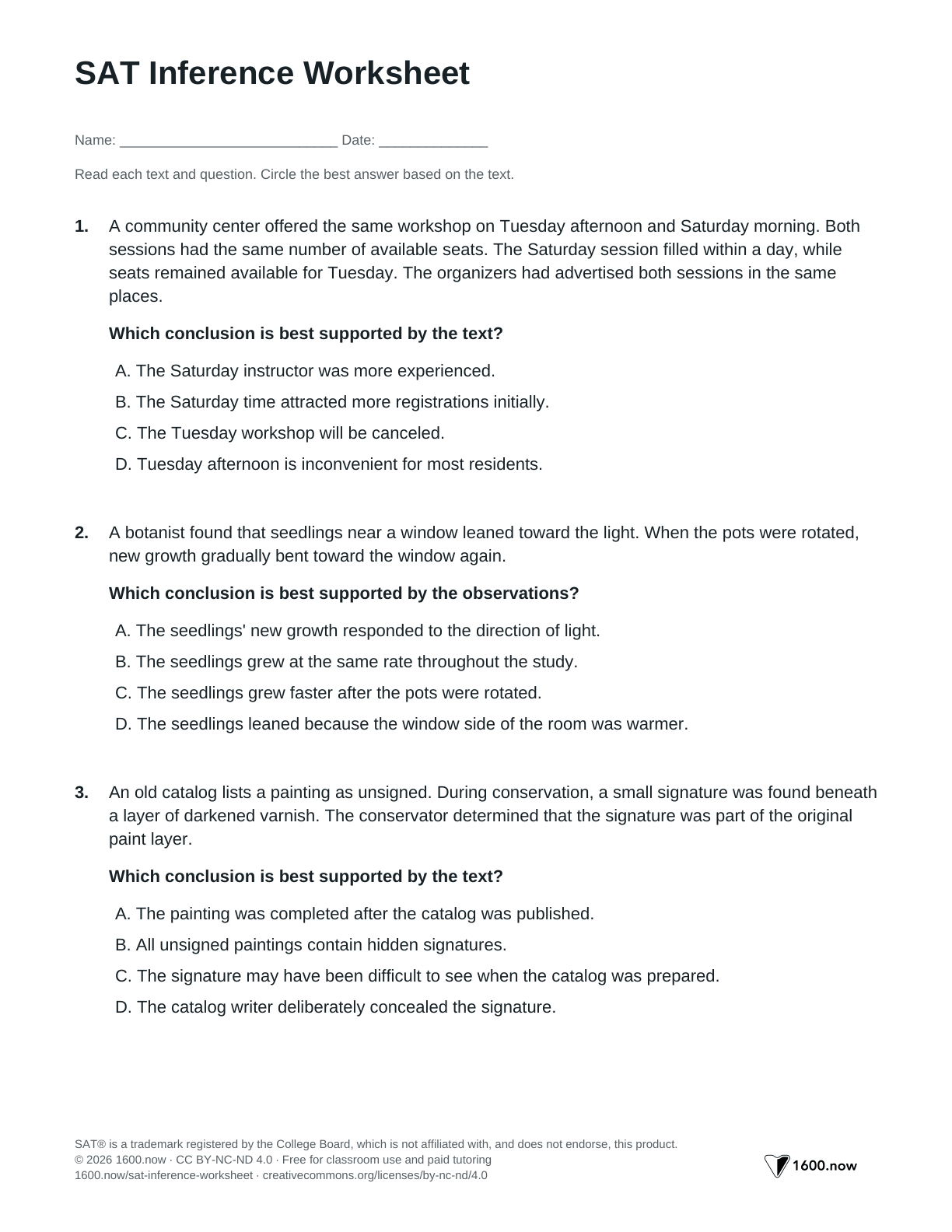
This 12-question worksheet uses observations, research results, and measurement limits. The student PDF leaves answers out; the full Letter/A4 version explains why the supported conclusion fits and the alternatives fail.
12 questions · about 25 minutes · Information and Ideas › Inferences
Share to Google Classroom · This worksheet is free to print and share under CC BY-NC-ND 4.0. Tutors may also use it in paid sessions. If you post it online, please link to this page instead of re-uploading the PDF. These are original questions, not College Board items.
Separate the observation from its explanation
List the observations first. If a Saturday workshop fills before a Tuesday workshop, the Saturday session attracted more initial registrations. That result alone does not establish why people preferred it or what will happen to Tuesday.
Check the method when evidence is missing. A recorder that saves only loud sounds can miss quiet activity; an empty recording does not establish an empty environment. The limits of the instrument belong in your conclusion.
Read the scope words in every choice. Some does not imply all, may does not imply must, and association does not establish a cause. For a tempting choice, name the extra evidence it would require. Reject it when that evidence is absent.
Try it yourself
Choose an answer.
Questions
Question 1
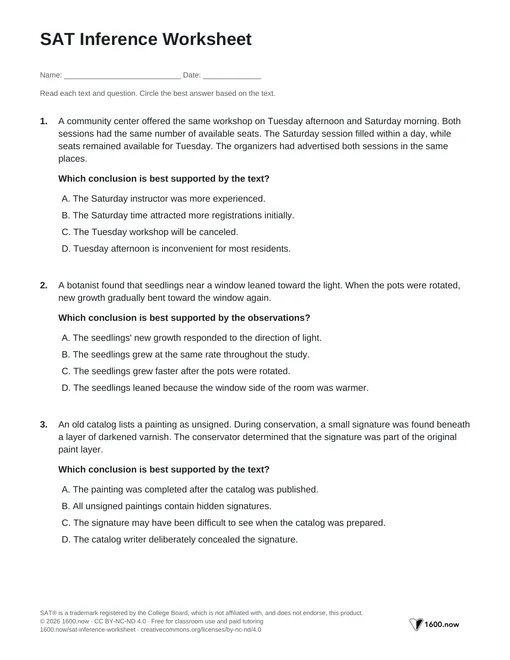
A community center offered the same workshop on Tuesday afternoon and Saturday morning. Both sessions had the same number of available seats. The Saturday session filled within a day, while seats remained available for Tuesday. The organizers had advertised both sessions in the same places.
Which conclusion is best supported by the text?
B. The registration patterns show only that more people signed up for Saturday at first. The text gives no reason for that and says nothing about instructors, residents' schedules, or canceling Tuesday.
Question 2
A botanist found that seedlings near a window leaned toward the light. When the pots were rotated, new growth gradually bent toward the window again.
Which conclusion is best supported by the observations?
A. After the pots were rotated, new growth bent back toward the window, so it followed the direction of the light. The botanist measured no growth rates or temperatures.
Question 3
An old catalog lists a painting as unsigned. During conservation, a small signature was found beneath a layer of darkened varnish. The conservator determined that the signature was part of the original paint layer.
Which conclusion is best supported by the text?
C. A signature beneath darkened varnish may have been hard to see. The evidence does not establish deliberate concealment, a later date, or a rule about all paintings.
Question 4
At a bakery, demand for small loaves rose after customers were allowed to buy half loaves. Sales of full-sized loaves fell, but the total weight of bread sold each week remained nearly unchanged.
Which conclusion is best supported by the text?
D. The stable total weight alongside shifting loaf sizes supports a change in purchase size, not a substantial change in bread quantity. Price and universal preference are not established.
Question 5
A scientist can measure the age of a rock sample with two methods. Method A requires much more material than Method B. The available sample is too small for Method A but large enough for Method B.
Which conclusion is best supported by the text?
B. The sample is too small for Method A but large enough for Method B, so only Method B can be used. Because Method B works, no more rock is needed, and the text says nothing about accuracy or which method is older.
Question 6
A writer's early drafts describe a narrator as certain of her memories. In the published version, the narrator repeatedly questions whether she remembers events correctly.
Which conclusion about the revision is best supported?
C. The narrator goes from certain to doubtful about her memories. The text doesn't say why the writer made that change or whether the memories are accurate, and the past events are still there.
Question 7
A shop began displaying repair instructions beside replacement parts. Afterward, fewer customers asked employees how to install the parts, although sales of the parts remained steady.
Which conclusion is best supported by the text?
A. Fewer installation questions while sales held steady fits the instructions answering some questions. Sales didn't rise, and fewer questions doesn't show that every customer read the instructions.
Question 8
A marine researcher used a sound recorder for one month. The device stored sound only when its sensor detected a signal above a set volume. Several hours in the file contain no recordings.
Which conclusion is best supported by the text?
B. Sounds below the threshold would not be stored. Missing recordings therefore do not prove total silence or identify a specific equipment failure.
Question 9
A sculptor made several small clay models before beginning a large stone work. In the models, the figure's pose changes repeatedly, but its facial expression remains nearly identical.
Which conclusion is best supported by the text?
C. The pose changes from model to model while the expression stays nearly the same, so the sculptor tried more versions of the pose. A steady expression doesn't show that the sculptor thought it unimportant, and the text never describes the finished stone work.
Question 10
A student found that two translations of a speech use different words but preserve the same sequence of arguments and examples.
Which conclusion is best supported by the text?
D. The translations use different words but keep the same sequence of arguments and examples. Nothing points to deception or to different source texts.
Question 11
A town offered free swimming lessons at two pools. Attendance was higher at the pool served by a bus route. The study did not collect information about instructors, pool size, or the neighborhoods served.
Which conclusion is best supported by the text?
A. Unmeasured differences could also explain attendance. The observation neither isolates bus access as the cause nor proves it irrelevant.
Question 12
A researcher repeated an experiment with a newly calibrated scale. The new measurements clustered more closely together, but their average remained almost the same.
Which conclusion is best supported by the text?
B. Clustering more closely means less variation, and the average barely moved. A steady average gives no sign that the old readings ran high, and with no known true value the text can't say which average is more accurate.
0/12 correct
Check your inference answers
Each row is a wrong answer choice from one of the sheet's problems, with the extra fact that choice would need.
| What your answer looked like | What actually happened | Fix it next time |
|---|---|---|
| “The Saturday instructor was more experienced” in problem 1 | The passage gives both sessions the same seats and the same advertising, then reports that Saturday filled first. It never mentions instructors, so this choice adds a cause the text doesn't give. | Keep to what the evidence shows: the Saturday time drew more registrations at first. If a choice explains why, find the sentence that gives that reason. No sentence, no answer. |
| “The catalog writer deliberately concealed the signature” in problem 3 | The signature sat under darkened varnish. That supports “hard to see,” not a motive; the passage says nothing about what the catalog writer intended. | Prefer the choice with the fewest new assumptions: the signature may have been difficult to see when the catalog was prepared. |
| “Every customer read the instructions” in problem 7 | Fewer customers asked employees how to install parts. That fits some customers using the instructions; it doesn't show that all of them did. | Treat every, all, always, and never as claims that need their own evidence. The supported choice says the instructions may have answered some questions. |
| “The sea contained no animals during those hours” in problem 8 | The recorder saved sound only above a set volume. Hours with no recordings could hold quieter sounds, so the gaps don't show silence, let alone an empty sea. | Read the limits of the method before you judge the result. The supported choice says the missing recordings don't establish that the surroundings were silent. |
| “Bus access was proved to have no effect” in problem 11 | The study didn't record instructors, pool size, or neighborhoods, so it can't isolate the bus route in either direction. It can't prove the bus mattered, and it can't prove it didn't. | When a passage lists what a study didn't measure, the answer holds back on causes. The supported choice says the attendance difference alone doesn't establish that bus access caused it. |
| “The new average was necessarily more accurate” in problem 12 | Clustering more closely means the new measurements varied less. Accuracy is closeness to the true value, and the passage never gives one. | Keep spread and correctness apart. The text supports less variation with about the same average, and nothing more. |
Worked example: testing each choice against the passage
In problem 4, a bakery lets customers buy half loaves. Demand for small loaves rises, sales of full-sized loaves fall, and the total weight of bread sold each week stays nearly unchanged. Before reading the choices, list what the passage establishes: the sizes people bought shifted, and the total amount of bread barely moved.
Now test each choice against that list. “The price per unit of weight must have increased” needs price data the passage never gives. “The bakery doubled its total production” contradicts the unchanged total weight. “Every customer preferred half loaves” turns a shift in sales into a claim about all customers. The remaining choice says customers changed the sizes they bought without substantially changing the total bread they purchased, which restates the two facts on your list.
Apply the check to fresh questions
For each rejected inference, identify the added assumption or the word that overstates the evidence. Then try the next Inferences practice questions without looking at the worksheet heading.