
Hard SAT Reading Worksheet
For these difficult reading questions, keep the claim and its qualification together. A result may support an association while leaving its cause open, or a source may show one period without representing every period.

The 12 questions mix evidence, inferences, purpose, and paired passages. They are an original practice set, not a scored SAT module. Use the student PDF first and the full PDF to review explanations.
12 questions · about 30 minutes · Reading and Writing › mixed skills
Share to Google Classroom · This worksheet is free to print and share under CC BY-NC-ND 4.0. Tutors may also use it in paid sessions. If you post it online, please link to this page instead of re-uploading the PDF. These are original questions, not College Board items.
Track what would change the conclusion
Write the finding, the proposed explanation, and the limit separately. If the author restricts a comparison to matching years, ask which alternative explanation that restriction excludes.
For an evidence question, change the factor the claim names while holding the other relevant factors steady. If two teaching methods are being compared, giving one group an additional demonstration leaves two differences instead of one.
For a challenge question, locate the link the conclusion depends on. If a method’s advantage appears immediately but disappears later, evidence of the same advantage at both times would undermine the timing claim. An unrelated preference would leave it intact.
Audit the last two choices word by word. Preserve direction: understate and overstate are opposites. Preserve certainty too: evidence that cannot establish a cause leaves the cause unsettled; it does not prove the cause has no effect.
Try it yourself
Choose an answer.
Questions
Question 1
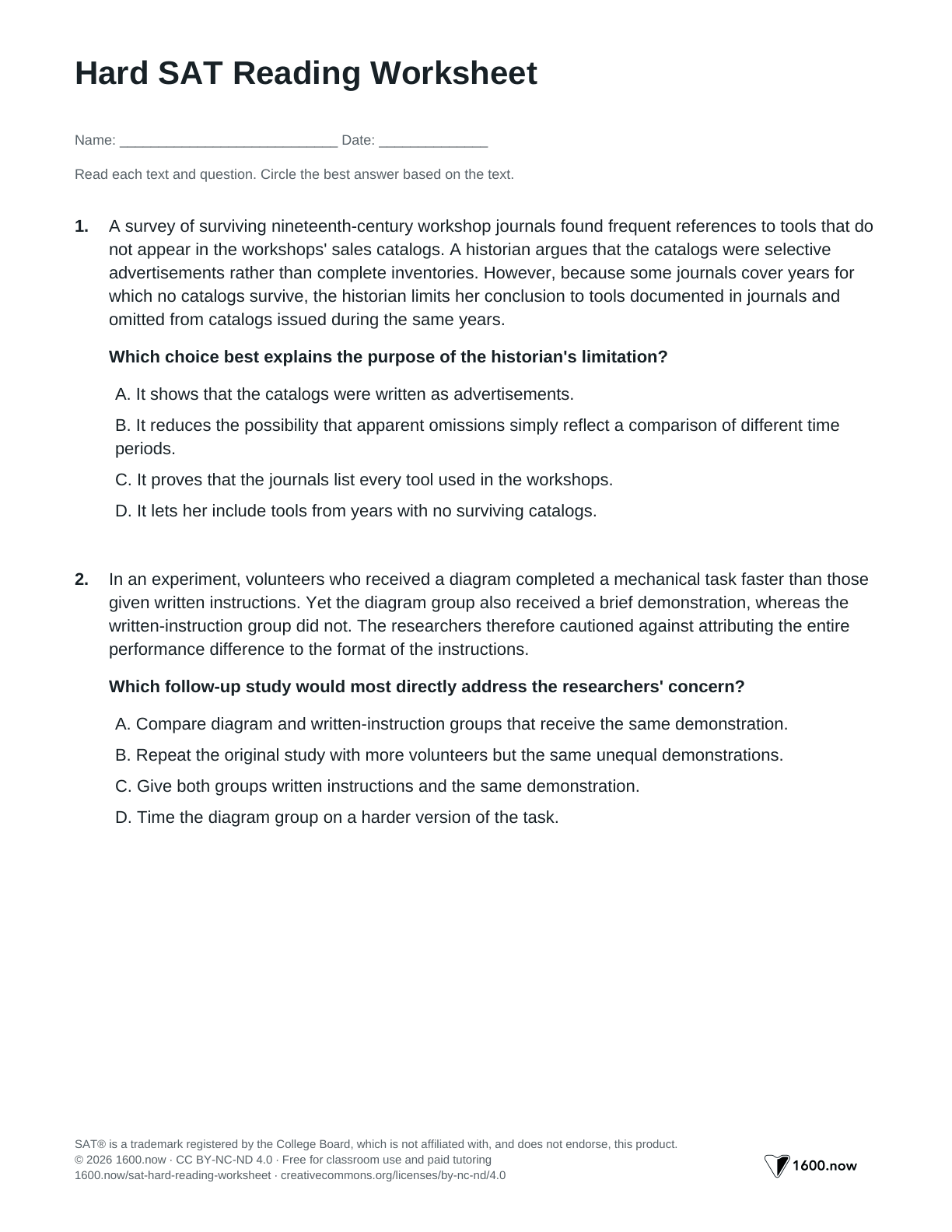
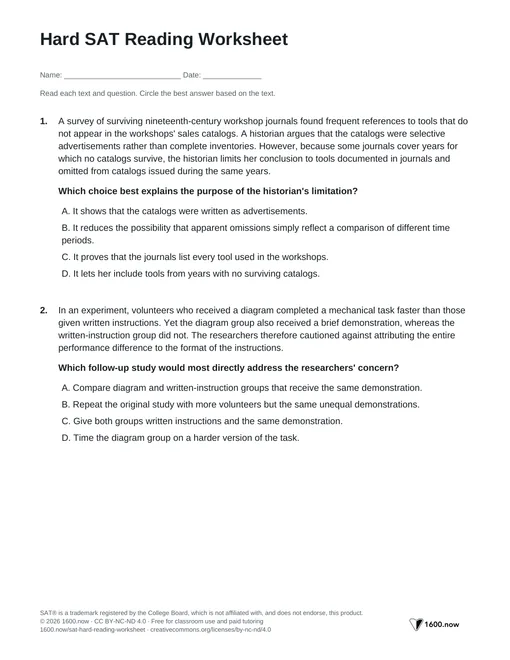
A survey of surviving nineteenth-century workshop journals found frequent references to tools that do not appear in the workshops' sales catalogs. A historian argues that the catalogs were selective advertisements rather than complete inventories. However, because some journals cover years for which no catalogs survive, the historian limits her conclusion to tools documented in journals and omitted from catalogs issued during the same years.
Which choice best explains the purpose of the historian's limitation?
B. Comparing journals and catalogs from the same years rules out one competing explanation: a tool might be missing only because the catalog came from a different period. The limitation leaves out years without catalogs, and it narrows her argument without proving it.
Question 2
In an experiment, volunteers who received a diagram completed a mechanical task faster than those given written instructions. Yet the diagram group also received a brief demonstration, whereas the written-instruction group did not. The researchers therefore cautioned against attributing the entire performance difference to the format of the instructions.
Which follow-up study would most directly address the researchers' concern?
A. Giving both groups the same demonstration leaves instruction format as the only difference. More volunteers would keep the unequal demonstration, and giving both groups written instructions removes the format comparison.
Question 3
Text 1Because a poem's unusual word order occurs in several passages, it is best understood as a deliberate stylistic choice rather than an accidental irregularity.
Text 2Repeated patterns can be deliberate, but repetition alone does not establish why a poet used them. The same pattern may serve a rhythmic purpose in one passage and emphasize a contrast in another.
How would the author of Text 2 most likely respond to Text 1?
C. Text 2 grants that repeated patterns can be deliberate but says repetition doesn't show why the poet used them; the purpose may differ from passage to passage. The answer has to keep both the agreement and the limit.
Question 4
A biologist found that insects visited flowers in shaded plots less often than flowers in sunny plots. Although shaded flowers produced less nectar, their color also appeared less distinct against surrounding leaves. The biologist hypothesized that visibility, rather than nectar quantity alone, contributed to the difference in visits.
Which finding would most directly support the hypothesis?
D. Changing visibility while holding nectar constant directly tests the proposed additional factor. Repeating the nectar difference cannot distinguish the visibility hypothesis from a nectar-only account.
Question 5
A literary scholar notes that a novelist's published essays praise plain language, while the novels contain elaborate descriptions. Rather than treating this as a contradiction, the scholar observes that the essays discuss instructions intended for immediate practical use, whereas the novels invite prolonged attention to an imagined world.
Which conclusion is best supported by the text?
B. The scholar ties each style to a purpose: plain language for practical instructions, elaborate description for fiction. That is why the scholar declines to call it a contradiction, and nothing suggests regret.
Question 6
An analysis found that neighborhoods with more public benches also had more pedestrians. The authors warned that this association did not show whether benches encouraged walking, whether planners placed benches where people already walked, or whether another feature influenced both.
Which statement would the authors most likely agree with?
C. The authors identify reverse causation and a possible common cause. Their caution concerns what the association can establish, not a claim that benches have no effect.
Question 7
A researcher observed that handwritten annotations in several copies of a textbook cluster around its worked examples rather than its definitions. She suggests that at least some readers used the book while solving problems. Because heavily used copies were more likely to be discarded, however, she cautions that the surviving books may understate this pattern.
Which choice best explains the researcher's caution?
C. Heavily used copies were thrown away more often, so the surviving copies may show less problem solving than actually happened. The pattern could be stronger than it looks, not weaker, and the annotations still count as evidence.
Question 8
A trial compared two methods of explaining a scientific concept. Students randomly assigned to Method A scored higher on an immediate quiz, but the groups performed similarly on a quiz a month later. The researchers concluded that the advantage depended on when learning was measured.
Which finding would most directly challenge that conclusion?
D. A similar advantage on both quizzes would mean the advantage did not depend on timing. Enjoyment or quiz length doesn't show that.
Question 9
Text 1When a language borrows a word, it often changes the word's pronunciation. Such changes show speakers fitting new vocabulary into familiar sound patterns.
Text 2Sound patterns help explain many changes in borrowed words, but speakers may also preserve an unusual pronunciation to signal a word's foreign origin or specialized use.
How would the author of Text 2 most likely respond to Text 1?
A. Text 2 agrees that sound patterns explain many changes and adds a reason some unusual pronunciations are kept. It doesn't make that reason the main explanation.
Question 10
A restoration team removed a yellowed coating from a painting, revealing brighter colors. A critic argued that the change recovered the artist's intended appearance. Yet tests showed that the pigments themselves had also changed chemically with age, in ways the cleaning could not reverse.
Which conclusion is best supported by the text?
B. Irreversible pigment changes remain even after the coating is removed. The evidence limits the claim of full recovery without proving that cleaning worsened the appearance.
Question 11
A city report notes that streets with frequent buses also have more shops. It proposes that bus service encourages commercial activity. A subsequent analysis finds that planners historically assigned frequent service to streets that already had many shops.
How does the subsequent finding affect the proposed explanation?
C. Existing commerce influenced bus-service decisions, so shop density may partly explain bus frequency. This alternative does not rule out an additional effect of buses on later commerce.
Question 12
A scholar compares two surviving drafts of a novel. In the later draft, descriptions of the setting are shorter, but conversations are longer. She argues that the revision shifts attention from the environment toward relationships among characters rather than simply making the entire work more concise.
Which observation most directly supports the distinction in the scholar's argument?
D. The distinction needs both changes, shorter descriptions and longer conversations. A draft that is only shorter overall, or only has shorter descriptions, would also fit a simple cut for length.
0/12 correct
Check your hard reading answers
Each row is a wrong answer choice from one of the sheet's problems, with the qualification it drops or reverses.
| What your answer looked like | What actually happened | Fix it next time |
|---|---|---|
| “It lets her include tools from years with no surviving catalogs” in problem 1 | The limitation does the reverse. She compares only journals and catalogs from the same years, which leaves out years with no catalogs. | Ask what a limitation removes. Matching the years rules out one explanation: a tool missing from a catalog only because the catalog came from a different period. |
| “Give both groups written instructions and the same demonstration” in problem 2 | It removes the unequal demonstration, and it removes the diagram too. With both groups on written instructions, there's no format left to compare. | A good follow-up changes one thing and holds the rest equal: compare diagram and written-instruction groups that receive the same demonstration. |
| “Flowers in sunny plots produced more nectar than shaded flowers” in problem 4 | That repeats the nectar difference already in the passage. It fits a nectar-only explanation just as well, so it can't support visibility. | To support a second cause, change that cause and hold the first one steady: making shaded flowers more visually distinct increased visits without changing their nectar quantity. |
| “Benches have no effect on how much people walk” in problem 6 | The authors say the association can't show whether benches encourage walking. That leaves the question open; it doesn't answer no. | When a passage says the evidence can't settle a question, keep it unsettled in both directions: the association alone can't establish a causal effect. Problem 11 has the same trap in “It proves that buses can never affect commerce.” |
| “It suggests that the surviving copies overstate how often readers solved problems” in problem 7 | Heavily used copies were more likely to be thrown away, so the books that survive are the less-used ones. They may show less problem solving than actually happened, which is an understatement. | Say which way a bias pushes before you choose. The researcher's caution identifies a preservation bias: the surviving copies may not represent all the copies that existed. |
| “Descriptions of the setting are shorter in the later draft” in problem 12 | True, but a draft cut only for length would show the same thing. The scholar argues the revision did more than make the work concise, so the evidence has to show something growing. | When an argument says rather than simply X, the evidence has to rule X out. Some kinds of passages expanded while others contracted, which a plain cut for length can't explain. |
Worked example: challenging a conclusion
Problem 8 describes a trial in which students taught with Method A scored higher on an immediate quiz, but the two groups scored about the same a month later. The researchers concluded that the advantage depended on when learning was measured. That conclusion rests on the difference between the two quiz results, so a finding that challenges it has to erase that difference.
A reliable reanalysis finding a comparably large Method A advantage on both quizzes does that: if the advantage is the same at both times, it doesn't depend on timing. The other choices leave the difference in place. Students enjoying Method B more is about preference, both groups finishing the later quiz is already assumed, and a shorter immediate quiz doesn't show that Method A's lead lasted a month.
Apply the check to fresh questions
For each miss, record the exact qualification you dropped or the competing explanation you overlooked. Then use Reading and Writing practice to test that check with a different passage.