
Hard SAT Math Worksheet
For hard SAT math practice, identify the requested quantity and the equation’s structure before doing a long calculation. Root relationships, parameter conditions, and domain restrictions can shorten the work and catch a false solution.

This original 12-question set covers challenging algebra, exponential models, and successive percent changes. It is a topic practice worksheet, not a scored adaptive test. Download it with or without the explained answer key.
12 questions · about 30 minutes · Math › mixed skills
Share to Google Classroom · This worksheet is free to print and share under CC BY-NC-ND 4.0. Tutors may also use it in paid sessions. If you post it online, please link to this page instead of re-uploading the PDF. These are original questions, not College Board items.
Look for a relationship before expanding
For , the sum of the roots is and their product is . If the roots have a stated ratio or difference, represent them with one variable, then use the sum or product to determine it.
Exactly one distinct real quadratic solution requires when . A parameter appearing inside is not necessarily the answer itself; solve the resulting parameter equation and then reconstruct the quadratic to check.
For exponential functions with , a ratio of outputs separates the growth factor from the starting value: . Count the interval length before taking a root or stepping backward.
After any transformation, return to the original restrictions and requested expression. A radical candidate must satisfy the unsquared equation, and squaring a sum must include its middle term.
Try it yourself
Choose an answer.
Questions
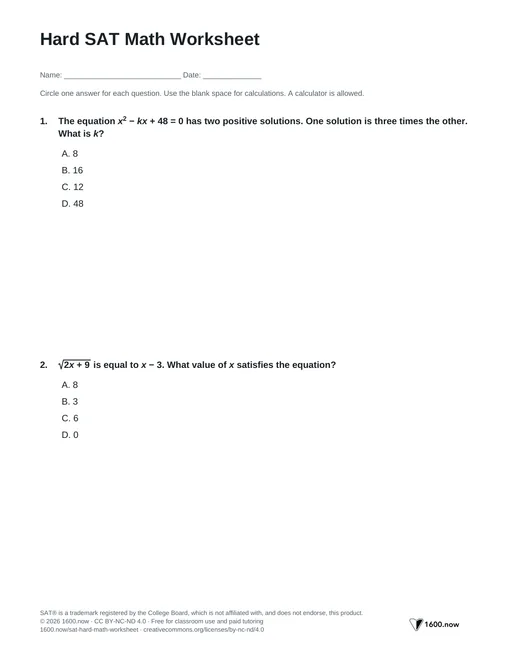
Question 1
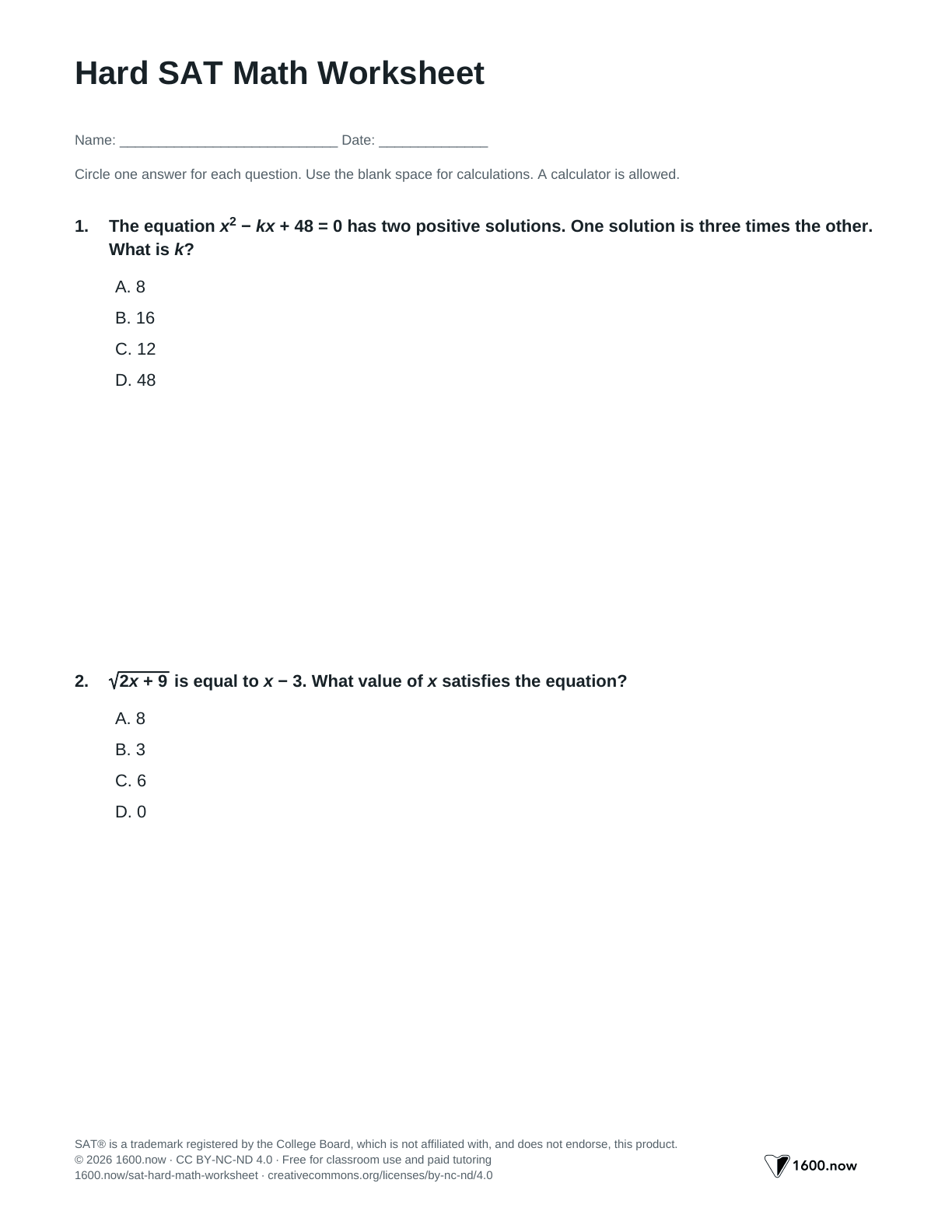
The equation has two positive solutions. One solution is three times the other. What is ?
B. Write the roots as and . Their product is 48, so and because both roots are positive. The roots are 4 and 12. Their sum equals , so .
Question 2
The square root of is equal to . What value of satisfies the equation?
A. Because a square root is nonnegative, must be at least 3. Squaring gives , so . The candidate 0 violates . The valid solution is 8: the square root of 25 equals .
Question 3
The graph has vertex (3, −4) and passes through (0, 14). What is ?
C. Vertex form is . Using (0, 14) gives , so . Expanding gives . Thus . Equivalently, evaluate at .
Question 4
The line intersects the parabola at exactly one point. If is positive, what is ?
D. Equating the expressions for gives . A single intersection requires . Thus is 4 or −4, giving or 7. The positive value is 7.
Question 5
A positive quantity is decreased by , then the result is increased by , where . The final quantity is 84% of the original. What is ?
B. The combined multiplier is . Set this equal to 0.84: , so . Since is positive, . Checking: 0.60 times 1.40 equals 0.84.
Question 6
For the quadratic function , , , and . What is ?
C. The -values are spaced by 2. Subtracting the first two equations gives ; subtracting the next two gives . Hence , so and . From , . Therefore .
Question 7
The equation has two positive roots whose difference is 4. What is ?
C. The roots sum to 10 and differ by 4, so they are 3 and 7. Their product equals the constant , giving .
Question 8
For positive constants and , . If and , what is ?
B. Dividing gives , so . Then , hence and .
Question 9
A quadratic has zeros −2 and 6. Its minimum value is −32. What is ?
B. Write . The vertex lies midway between the zeros at , where , so . Then .
Question 10
For which positive value of does have exactly one real solution?
B. Rearrange to . A repeated root requires discriminant , so .
Question 11
A positive quantity is increased by and then increased by . The result is 168% of the original. What is ?
B. Set . With the factors are 1.2 and 1.4, whose product is 1.68. The other algebraic root is negative and is excluded.
Question 12
If for a nonzero real , what is ?
C. Squaring gives . Subtract 2 to obtain the requested expression, 23.
0/12 correct
Check your hard math answers
Each row is a wrong answer choice from one of the sheet's problems. Find the one you picked, then run the check in the last column.
| What your answer looked like | What actually happened | Fix it next time |
|---|---|---|
| 0 in problem 2 | Squaring both sides added a solution. At , , but . | A square root can't be negative, so and . Only 8 works: . |
| 16 in problem 5 | 16 is , the net loss. Each change has to be larger than that, because the increase is taken from a smaller amount. Test 16: , not 0.84. | Multiply the factors: , so and . Check: . |
| 24 in problem 7 | 24 is . Those roots add to 10, but they differ by 2, not 4. | Find two numbers that add to 10 and differ by 4: 3 and 7. In , is their product, 21. Check: . |
| 6 in problem 8 | 6 is : you divided by once. Going from back to divides by twice. | From , . Then . |
| 16 in problem 10 | 16 is the value of , the constant term of . | One solution means the discriminant is 0: , so and . Check: . |
| 25 in problem 12 | You squared each term and dropped the middle one. , because . | Square both sides: . Subtract 2 to get 23. |
Worked example: roots in a 1-to-3 ratio
Problem 1 says has two positive solutions, one three times the other. Call them and . Then the quadratic factors as .
Match the constants: , so and , since the roots are positive. The roots are 4 and 12. Match the -terms: . Check: . The choice 12 is the larger root, and 48 is the product of the roots.
Apply the check to fresh questions
For each miss, name the structure you could have used: root sum/product, discriminant, growth factor, or domain restriction. Use the Math practice link to apply it without a worksheet topic cue.