
SAT Paired Passages Worksheet
For paired SAT passages, summarize each author’s position separately, then identify the specific agreement, disagreement, or qualification the question requests. Agreement with one point can coexist with an objection to another.

This 12-question worksheet asks how authors respond to each other and where their views overlap or differ. Download the student copy for a blind attempt or the full PDF for explanations.
12 questions · about 25 minutes · Craft and Structure › Cross-Text Connections
Share to Google Classroom · This worksheet is free to print and share under CC BY-NC-ND 4.0. Tutors may also use it in paid sessions. If you post it online, please link to this page instead of re-uploading the PDF. These are original questions, not College Board items.
Compare claims rather than shared topics
Write "Text 1 says…" and "Text 2 says…" in a line each. Include quantity and certainty words. An author who says some projects require originals has not said scans are useless or that all projects require originals.
For an agreement answer, find support in both texts. A useful idea mentioned only in Text 2 cannot be something both authors endorse without evidence in Text 1.
For a response question, identify whether Text 2 accepts, qualifies, or challenges Text 1’s claim. Keep the point it accepts as well as the limit it adds. If the authors accept the same numbers but disagree about the cause, describe that disagreement rather than inventing a dispute over the measurement.
Try it yourself
Choose an answer.
Questions
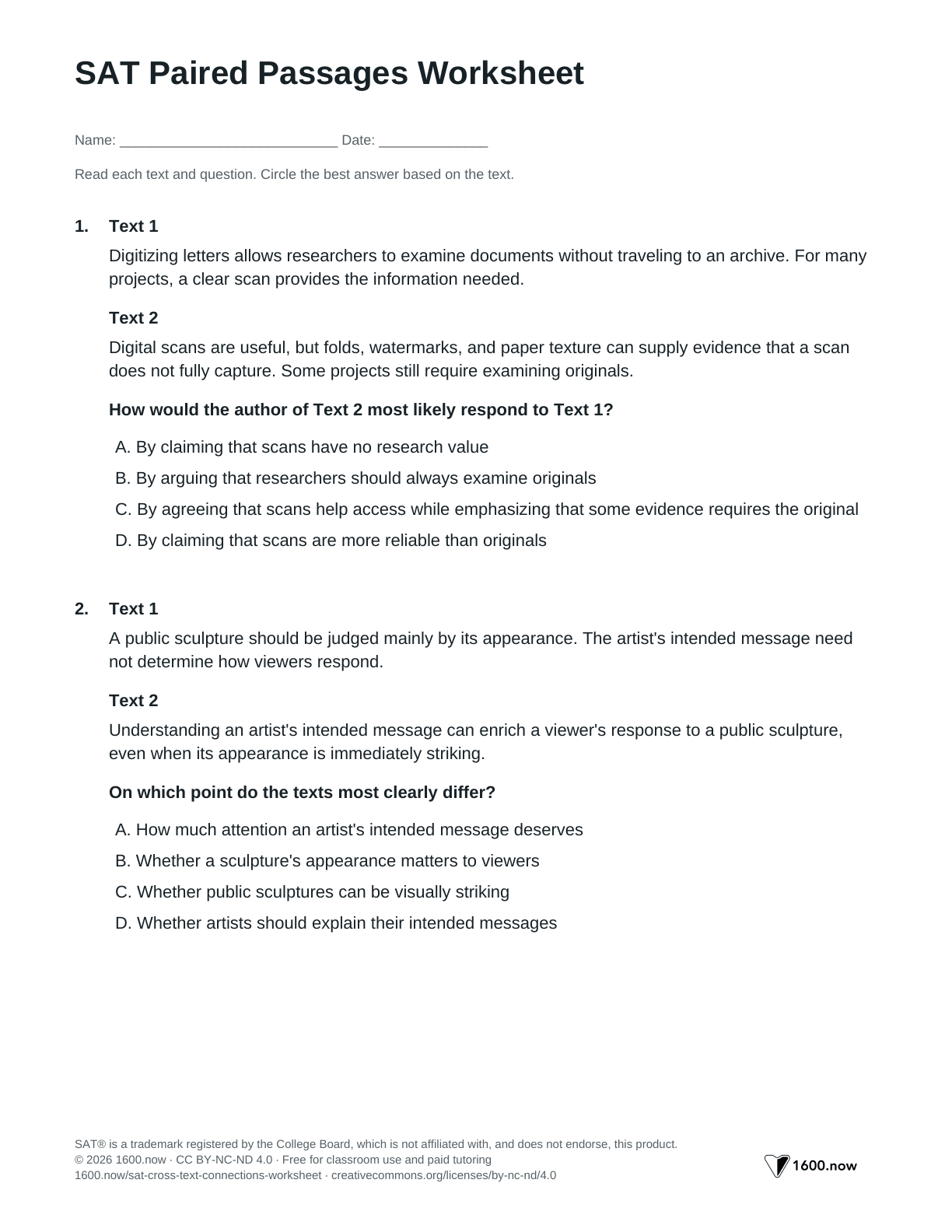
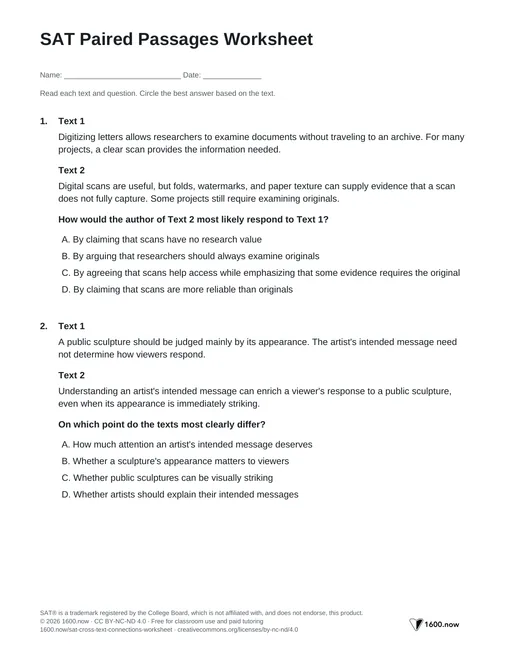
Question 1
Text 1Digitizing letters allows researchers to examine documents without traveling to an archive. For many projects, a clear scan provides the information needed.
Text 2Digital scans are useful, but folds, watermarks, and paper texture can supply evidence that a scan does not fully capture. Some projects still require examining originals.
How would the author of Text 2 most likely respond to Text 1?
C. Text 2 grants that scans are useful but says folds, watermarks, and paper texture can require the original. It says some projects need originals, not all of them.
Question 2
Text 1A public sculpture should be judged mainly by its appearance. The artist's intended message need not determine how viewers respond.
Text 2Understanding an artist's intended message can enrich a viewer's response to a public sculpture, even when its appearance is immediately striking.
On which point do the texts most clearly differ?
A. Text 1 plays down the artist's intended message; Text 2 says knowing it can enrich a response. Neither denies that appearance matters, and neither says artists should explain their work.
Question 3
Text 1Community gardens can give residents a place to exchange growing advice and work together. These social benefits deserve attention alongside food production.
Text 2The value of a community garden cannot be measured only by the amount harvested. Shared work can also strengthen connections among neighbors.
Both authors would most likely agree with which statement?
D. Both texts name social benefits beyond the harvest. Neither ranks those benefits above food, and both reject judging a garden by its harvest alone.
Question 4
Text 1A rise in recorded bird sightings near the lake suggests that the local bird population has increased.
Text 2The number of volunteers reporting lake birds doubled this year. More reported sightings may reflect greater observation effort rather than a larger bird population.
How does Text 2 relate to Text 1?
B. More volunteers can report more sightings without any more birds, so Text 2 offers another explanation. It doesn't show that the population rose, fell, or doubled.
Question 5
Text 1Using local stone helps a new building resemble older structures nearby. This visual continuity can be a reason to choose the material.
Text 2A building material should be selected with attention to durability and maintenance as well as appearance. Local stone may look appropriate without being the best choice for every site.
How would the author of Text 2 most likely respond to Text 1?
D. Text 2 keeps appearance as a reason and adds durability and maintenance. It doesn't rank those above appearance.
Question 6
Text 1A translation can preserve a poem's literal meaning while losing its rhythm. Readers should consider sound as well as vocabulary when comparing translations.
Text 2Translators must make decisions about both meaning and musical effects. Two accurate translations can therefore create different reading experiences.
Both authors would most likely agree with which statement?
C. Both authors treat sound as part of a poem alongside its literal meaning. Neither ranks sound above meaning or favors the most literal version, and Text 2 says two accurate translations can differ.
Question 7
Text 1Restoring a historic building should preserve visible signs of age. Replacing worn surfaces can remove evidence of how the building was used.
Text 2Signs of age can be informative, but a building still used by the public must meet safety needs. Some worn surfaces require replacement even when they have historical value.
How would the author of Text 2 most likely respond to Text 1?
A. Text 2 grants that signs of age are informative and adds public safety. It says some worn surfaces need replacing, not all of them.
Question 8
Text 1A city should judge a bicycle route mainly by the number of trips made on it. High usage shows that the route serves a practical need.
Text 2Usage is useful, but a route may also connect neighborhoods that previously lacked safe access. Such a connection can matter even before large numbers of riders adopt it.
On which point do the authors most clearly differ?
B. Both authors find usage useful. Text 1 makes it the main measure, while Text 2 says a new connection can matter before many people ride it.
Question 9
Text 1Reading an old recipe can reveal which ingredients its writer expected readers to obtain. Even an unsuccessful attempt to cook it may teach us about past food practices.
Text 2Historical recipes provide evidence beyond the dishes they produce. Their instructions can reveal assumptions about tools, skills, and ingredient availability.
Both authors would most likely agree with which statement?
C. Both texts say recipes show past practices or assumptions, whether or not the dish turns out. Neither calls cooking the best way to learn from them.
Question 10
Text 1More nesting birds were counted after shrubs were planted along the school fence. The new shrubs may have improved nesting habitat.
Text 2The count also took place later in spring than previous counts. Because nesting activity changes during the season, the timing difference should be considered before crediting the shrubs.
How does Text 2 relate to Text 1?
D. A count later in spring could find more nesting birds, so Text 2 gives another possible reason for the increase. It doesn't rule out the shrubs or doubt the count itself.
Question 11
Text 1A translation should closely follow the sentence structure of the original so readers can experience the author's arrangement of ideas.
Text 2Following an original sentence structure too closely can make a translation difficult to understand. Sometimes rearrangement better preserves how naturally the ideas reach the reader.
What is the central disagreement between the texts?
A. Text 1 wants the original sentence structure kept; Text 2 allows rearranging it so the ideas read naturally. Both want the author's ideas to come through, and neither discusses word choice or notes.
Question 12
Text 1Classifying a newly found object by its shape is a useful first step, but objects with similar shapes can have different functions.
Text 2Wear marks and the location where an object was found can help identify its use. These clues are especially valuable when shape alone is inconclusive.
Both authors would most likely agree with which statement?
B. Text 1 says objects with similar shapes can have different functions, and Text 2 turns to other clues when shape is inconclusive. Text 1 never mentions wear marks.
0/12 correct
Check your paired passages answers
Each row is a wrong answer choice from one of the sheet's problems, with the sentence in either text that rules it out.
| What your answer looked like | What actually happened | Fix it next time |
|---|---|---|
| “By arguing that researchers should always examine originals” in problem 1 | Text 2 calls scans useful and says “some projects still require examining originals.” The word always turns a limited objection into a rule. | Carry the second author's quantity word into your prediction. Some projects need originals, so Text 2 agrees that scans help access and adds that some evidence requires the original. Problem 7 turns on the same word: some worn surfaces, not every case. |
| “Whether artists should explain their intended messages” in problem 2 | Neither text says what artists should do. Both are about how viewers respond. | Find the sentence in each text that takes a side. Text 1 says the artist's intended message need not determine how viewers respond, and Text 2 says understanding it can enrich a response. They differ on how much attention the message deserves. |
| “By arguing that durability matters more than appearance” in problem 5 | Text 2 says a material should be chosen for durability and maintenance “as well as appearance.” That puts the criteria side by side without ranking them. | Text 2 accepts visual continuity as one consideration and adds durability and maintenance to it. |
| “Whether usage data are useful at all” in problem 8 | Text 2 opens with “Usage is useful,” and Text 1 relies on usage. A point both authors accept can't be where they differ. | Cross out whatever your two summary lines share. What's left: Text 1 makes usage the main measure of a route, and Text 2 says a new connection can matter before many people ride it. |
| “It questions whether the birds were counted correctly” in problem 10 | Text 2 doesn't doubt the count. It says the count took place later in spring, and nesting activity changes during the season, which could explain the rise without the shrubs. | Separate a challenge to the numbers from a challenge to the explanation. Text 2 accepts the higher count and names another factor that could explain it. Problem 4 does the same with the doubled number of volunteers. |
| “Wear marks are more reliable than shape for identifying function” in problem 12 | Text 1 never mentions wear marks, so there's nothing for its author to agree with. Text 2 calls them especially valuable only when shape alone is inconclusive. | An agreement answer needs support in both texts. Text 1 says objects with similar shapes can have different functions, and Text 2 looks for other clues when shape is inconclusive: shape may be insufficient to establish function. |
Worked example: what both authors would agree with
Problem 9 pairs two short texts about old recipes and asks what both authors would agree with. Write a line for each first. Text 1: a recipe shows which ingredients its writer expected readers to obtain, and even a failed attempt to cook it can teach something about past food practices. Text 2: recipes are evidence beyond the dishes they produce, and their instructions show assumptions about tools, skills, and ingredient availability.
The overlap is that a recipe tells you about the past whether or not the dish comes out, which is the choice about recipes providing historical information apart from a successfully prepared dish. “Cooking an old recipe is the best way to learn from it” ranks cooking first, and neither text does that. “A recipe cannot reveal anything about its audience” contradicts Text 1, which says a recipe shows what its writer expected readers to obtain. Neither text says anything about the skills of modern readers.
Apply the check to fresh questions
Use one line per author on the next paired-passages question. Highlight the exact point where the two lines overlap or diverge, then check your choice in the Cross-Text Connections practice.
Review the cross-text connections method